
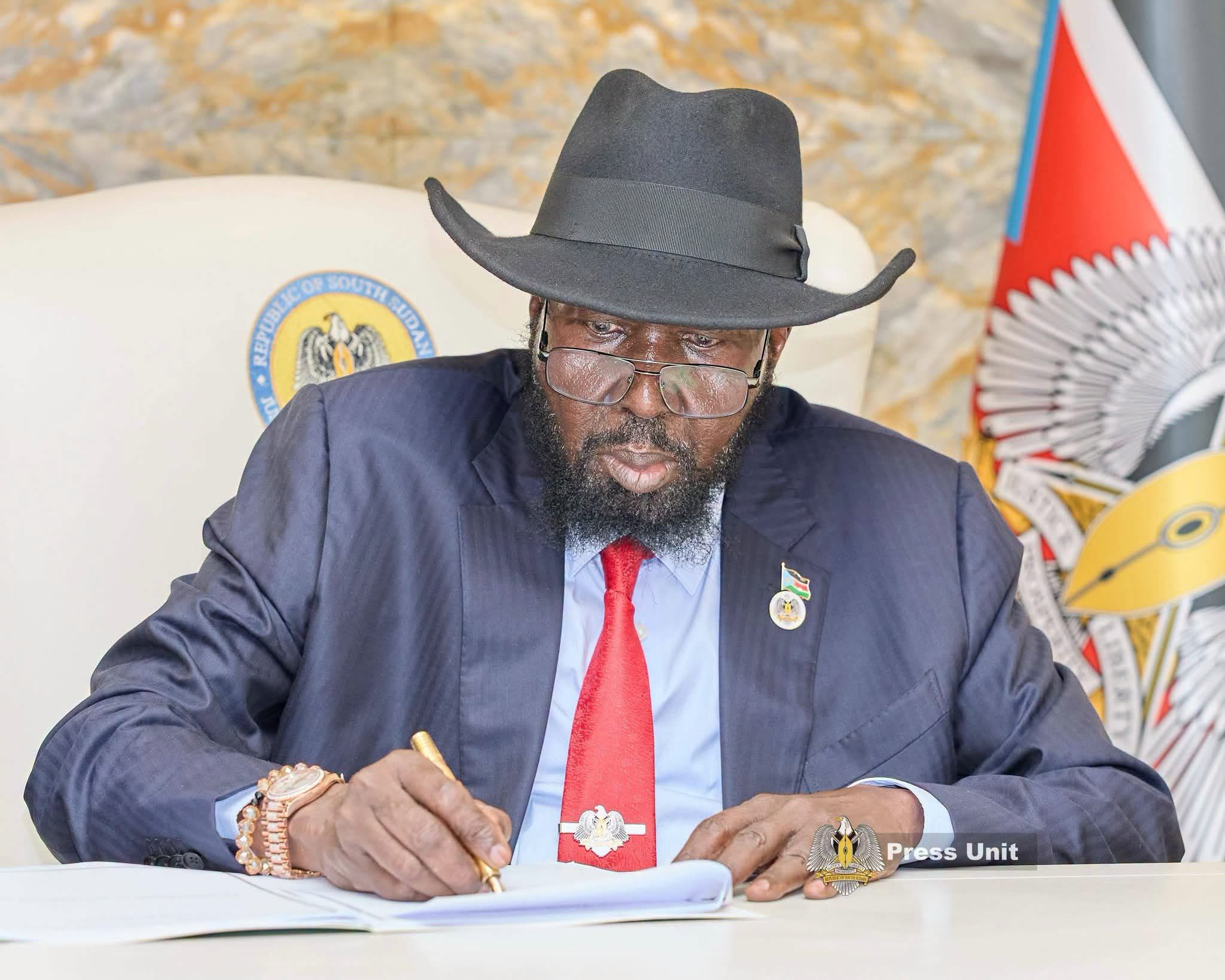
JUBA — President Salva Kiir has signed amendments to South Sudan’s National Elections Act into law, completing a rapid legislative process ahead of general elections scheduled for 22 December.
South Sudan Broadcasting Corporation reported that Kiir assented to the National Elections Act, 2012 (Amendment) Bill, 2026 on 21 September after the National Legislature passed the measure earlier that day.
What changed
The bill is now law. But enactment should not be confused with implementation: South Sudan Press has not independently verified separate decrees removing Vice Presidents or dissolving national or state institutions.
What the amended law reportedly provides
SSBC says the amended law keeps the incumbent executive leadership in office with constitutional powers during the election period until an elected President assumes office. It also gives the President powers, within three months before the election date, to relieve the First Vice President and other Vice Presidents under the cited constitutional provision.
Parliamentary reporting says the legislation also provides for dissolution of the National Legislature, state assemblies and state governments within the pre-election period. The law also operationalises the “delink” principle, separating elections from completion of the permanent constitution-making process and national census.
Enactment is not the same as dismissal
As of publication, SSP has not independently located separate presidential instruments implementing removals or dissolutions. Officeholders should therefore not be described as already removed solely because the amendment has been enacted.
A major numerical discrepancy
The official reporting itself contains a material inconsistency. SSBC’s presidential-assent report says the amended law sets the National Legislative Assembly at 270 members. Its report on parliamentary passage says the composition is 332 members. Other reporting also refers to 66 appointed representatives.
SSP is therefore withholding a definitive figure until the authenticated, gazetted Act is available.
Opposition objections remain
Opposition actors, including SSOA, have argued that unilateral changes affecting structures created by the 2018 peace agreement are incompatible with agreed arrangements. That is a political and potentially legal challenge; it is not, by itself, a court judgment invalidating the new law.
What happens next
The immediate questions are whether implementing decrees are issued, when the law formally commences, how voter-registration deadlines will operate, how diaspora and prisoner voting will be administered, and which institutional arrangements will govern the period before polling.
Election Resource
Follow the election timeline, constituencies and civic-information resources at SouthSudanElections.org.