SATURDAY, 24 OCTOBER 2026 · ECONOMIC ANALYSIS · MARKETS
A Cheaper Month Does Not Necessarily Mean Affordable Food
FAO’s September Juba assessment shows why price changes must be read alongside price levels and household incomes.
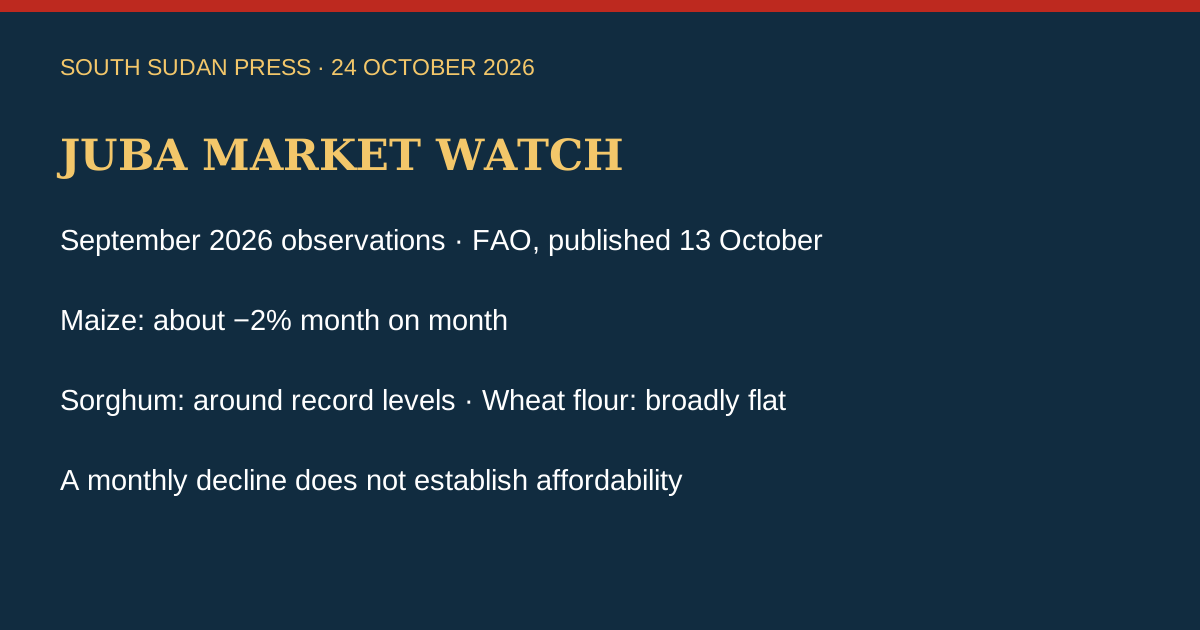
A small monthly fall in the price of one staple can be welcome without making food affordable. The distinction is between the direction of a price, its level and the income available to pay it. South Sudan’s market debate needs all three. [1]
FAO’s 13 October assessment reported that maize prices in Juba declined by about two per cent in September, extending a run of decreases after a June peak. Sorghum remained around record levels, while imported wheat flour was broadly unchanged that month after a substantial earlier rise. These observations concern particular commodities, a particular market and a defined reporting period.
They cannot establish that all food became cheaper across South Sudan, or that October prices match September’s. Nor can a decline in maize alone describe the cost of a household basket containing other foods, fuel, transport and essential services.
Consider the arithmetic without treating it as a local quotation. If an item rises from 100 to 150 and then falls two per cent, it costs 147. The latest movement is downward, but the item remains far more expensive than at the starting point. The example illustrates how a modest decline can coexist with continued strain.
Affordability adds another variable: income. The same basket is easier to buy for a household with regular earnings than for one whose income is delayed, intermittent or lost. A price index cannot describe that difference on its own. Market reporting should therefore ask not just what a sack costs, but how much food an ordinary day’s earnings can purchase.
Geography matters too. Differences in transport costs, seasonal access, competition and local supplies can prevent a movement in Juba from reaching another town quickly or at all. A responsible comparison uses the same commodity, quality, unit and date across markets rather than treating isolated trader quotations as a national average.
For readers, a useful weekly service would publish a small, consistent basket with its collection date, market location and unit of measurement. It would distinguish observed prices from forecasts and explain any gaps in collection. That would make changes easier to compare and harder to exaggerate.
September’s maize decline offers a limited positive signal. The broader question remains whether a household can regularly buy enough food after paying its other essential costs. That is the test of relief, and it requires evidence about income as well as prices.
Prepared from the linked published material and the publisher’s supplied brief. SSP has not conducted new interviews or independent field verification for this edition.