GUEST OPINION · TRANSLATED FROM ARABIC · 6 NOVEMBER 2026
From Exclusion to Downfall: How Did Salva Kiir Repeat Stalin’s Mistake?
Boi Rual Makoy argues that sidelining rivals and rewarding loyalty have weakened the SPLM and South Sudan’s institutions.
By Boi Rual Makoy (بوي روال مكوي)
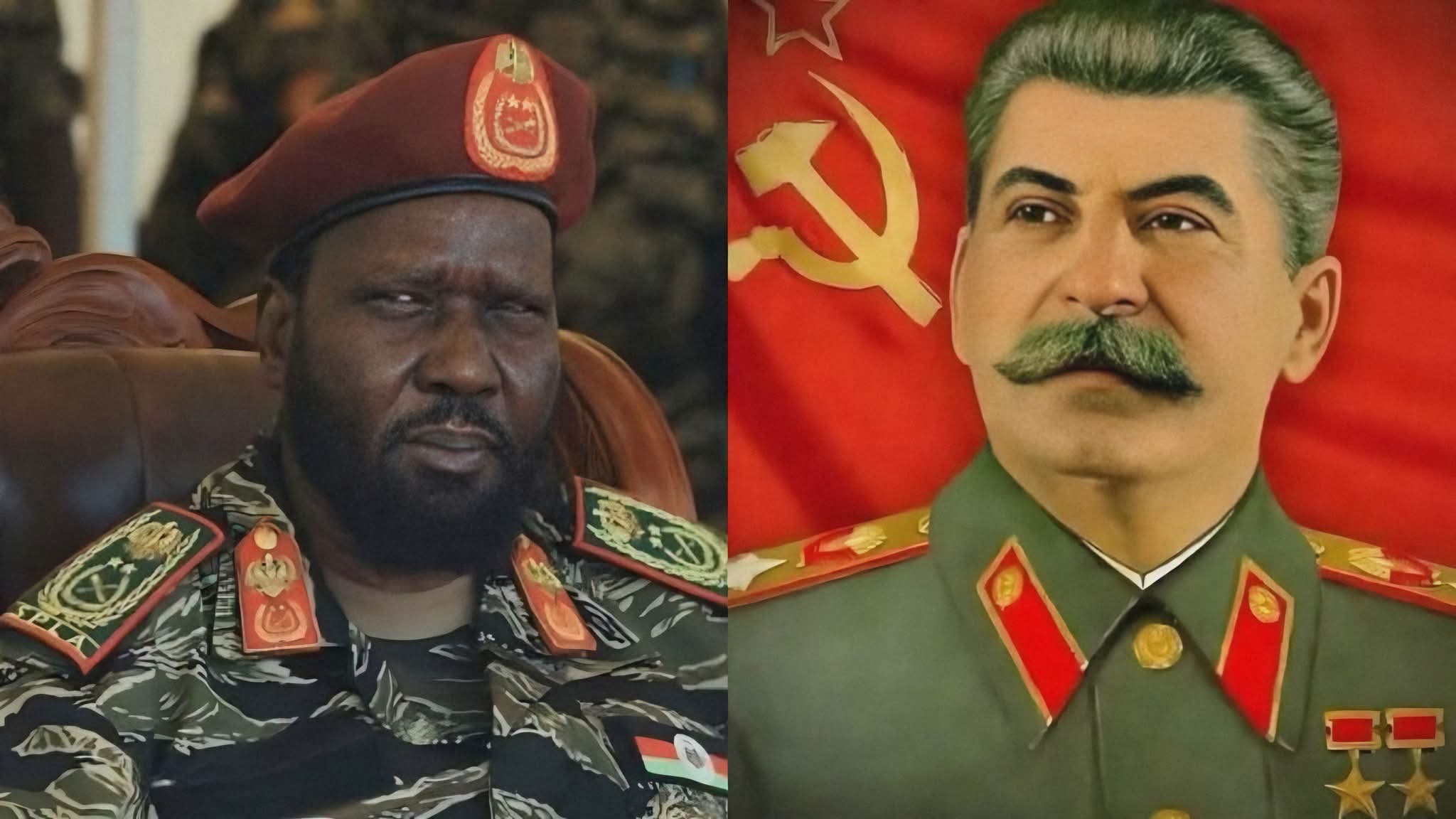
The politics of exclusion that President Salva Kiir and the Sudan People’s Liberation Movement (SPLM) have pursued since the signing of the Comprehensive Peace Agreement in 2005 resemble, in my view, the policies of Stalin and the Soviet Communist Party before and after the Second World War.
Stalin, who became the Communist Party’s general secretary in 1922, consolidated his power after Lenin’s death in 1924. He could not tolerate popular figures alongside him. He sidelined rivals such as Leon Trotsky, Nikolai Bukharin and Lev Kamenev, who were eventually killed. After the Second World War, he marginalised Vyacheslav Molotov and sent Marshal Georgy Zhukov to a military command in Odesa. Stalin had old comrades killed in the name of protecting the revolution. What he was protecting, in my view, was his monopoly on power.
Stalin’s policies helped bring about the Holodomor, one of the most devastating famines in recorded history, in which more than three million people died. The Soviet Union then lost more than 25 million civilians and soldiers in the Second World War. In my reading, the purges of senior military officers before the war made those losses worse. I believe that without Zhukov’s leadership and the enormous sacrifices of the Soviet people, Moscow could have fallen and the Soviet Union could have broken apart.
Unfortunately, Kiir did not learn from that history. After the SPLM gained the mandate to lead southern Sudan and Kiir succeeded John Garang after his death, the movement could have opened the door to others. Instead, I argue, it excluded parties, thinkers and people with ideas that could have made a real contribution to building the state.
Other southern and Sudanese parties were marginalised, independent thinkers and opposition newspapers were silenced, and those with a different vision were pushed aside, however sincere their commitment to the country. The vision I am speaking of is the one I believe died with Dr John Garang, may he rest in peace. What we see today is a distortion of it.
Once exclusion had reached parties and independent thinkers, it turned inward. In my view, military and political leaders who gained a following or called for reform found themselves accused of plotting a coup, rebellion, conspiracy or disloyalty. Some were removed, arrested or driven back into armed opposition. The young state came to resemble a one-party system: one man visibly in charge, with others, in my view, exercising influence out of sight.
Kiir’s aim, as I see it, was to build a system of unquestioning loyalty through patronage and the distribution of posts. Competence became grounds for suspicion, ideas became a threat and criticism was treated as betrayal. Keeping one’s position came to depend on proximity to the president rather than on what one could do for the public.
The result, in my view, is a state with hollowed-out institutions, rife with corruption, and a party without a vision or a programme for building the country. The economy has collapsed, communities have been pitted against one another, and recurrent civil war has devastated the country and torn its social fabric. Hundreds of thousands have died, and millions have been forced from their homes, within the country and across its borders.
A revolutionary movement that once gave southern Sudanese people hope for a dignified life and equal opportunity has, in my view, become an instrument of one man. I would go further: the state has come to serve one family. But that is a subject for another day.
The difference I want to draw is this: Stalin killed rivals in Moscow and banished others to places such as Odesa, the Urals and Siberia. In South Sudan, exclusion fed civil war, as sidelined leaders could mobilise armed forces and draw on communal loyalties. The leader stays, the party breaks, and the people pay.
Stalin’s mistake went beyond force and cruelty. It was exclusion. He thought a state could be built by silencing critics and killing rivals. He created a party that rewarded people for saying what those in power wanted to hear. In my view, that habit outlasted him, through the years of Nikita Khrushchev and Leonid Brezhnev. By the time Mikhail Gorbachev took power in the 1980s, decay had set in within both the Communist Party and the Soviet Union.
It is a lesson South Sudanese people and the leadership of the red party have been reluctant to learn: no state can survive indefinitely by governing through exclusion. A country is built when its people work together in a national partnership that treats difference and diversity as strengths, and values knowledge and competence.
What is happening in our beloved South Sudan is neither an accident nor a fate written in advance. It is, I believe, the result of choices Kiir and his party made when they put exclusion ahead of partnership, patronage and loyalty ahead of competence, and power ahead of country. That same habit, in my reading, helped bring down the Soviet Union. If it continues, I believe it will bring down the SPLM, a movement already fighting for breath.
Author’s disclosure: The author states that he is independent and does not belong to any political party or opposition organisation.