OPINION · 6 NOVEMBER 2026
The SPLM Should Adopt a Name That Reflects the Country It Now Governs
A debate about the party’s name should be a debate about internal democracy, public accountability and the separation of party and state.
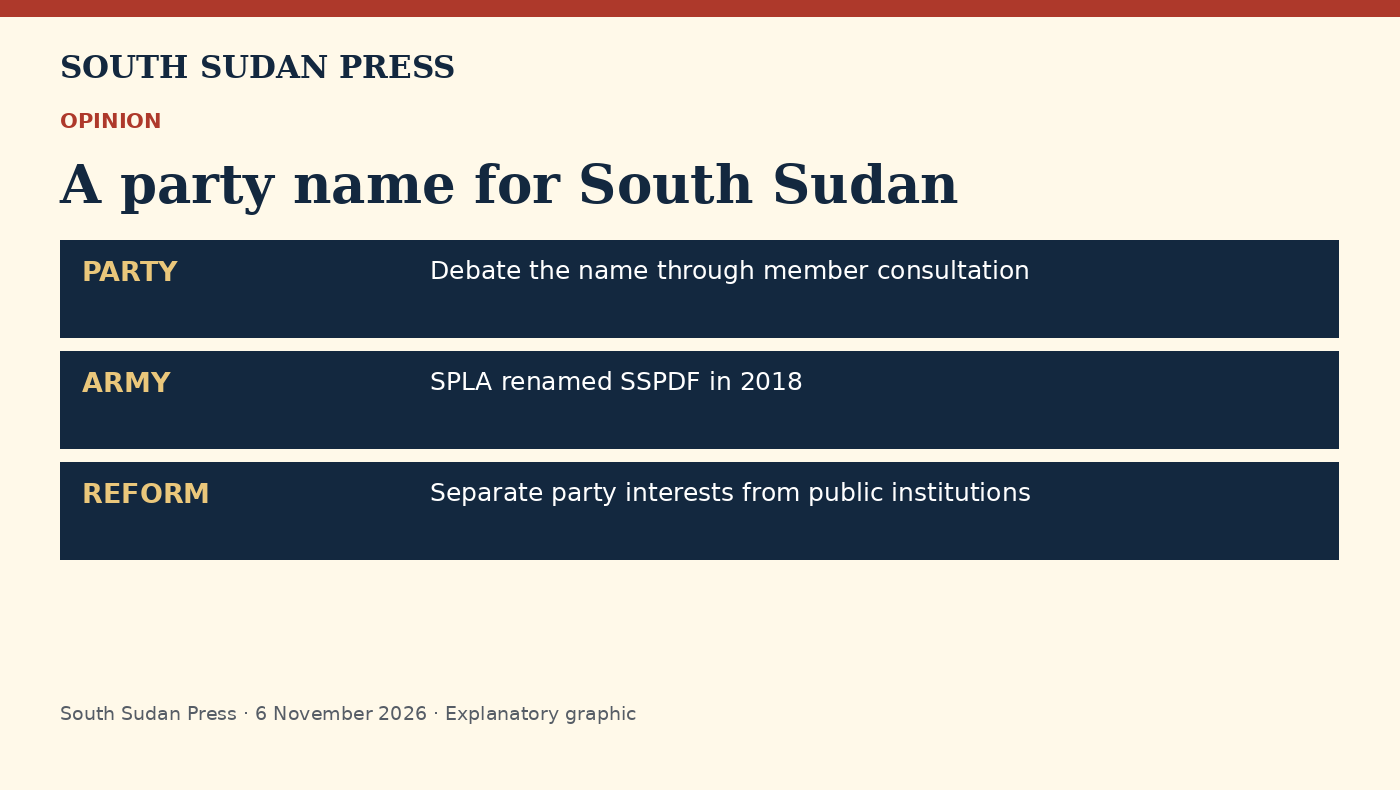
South Sudan’s independence changed the political map. The party that governs it should now consider whether its name reflects that change and whether its institutions have completed the transition from liberation movement to civilian political organisation.
The Sudan People’s Liberation Movement carries a name rooted in the struggle that began in 1983. That history deserves recognition. It should not prevent members from asking how their party should identify itself in an independent South Sudan.
The national army has already been renamed. A presidential order of 2 October 2018 changed the name of the Sudan People’s Liberation Army to the South Sudan People’s Defence Forces. The SPLM should debate its party name; the SSPDF should demonstrate the national, professional identity its name promises.
A name for the independent republic
“Sudan” in the SPLM’s name records its origins. It does not prove foreign allegiance or make the party illegitimate. Yet it invites a reasonable question: why should the governing party still identify itself primarily through the political geography of the struggle that preceded independence?
A name incorporating South Sudan could express a clearer commitment to the republic and its citizens. Members could also debate whether “movement” is still the right description for an organisation seeking electoral mandates. The decision should emerge from open consultation. A change imposed from above would miss the point of reform.
Historical legitimacy is not a permanent mandate
A liberation movement can appeal to sacrifice and solidarity. A governing party must answer for public services, economic management, political freedoms and the use of public funds. Citizens should be able to judge its performance without being treated as opponents of the liberation struggle.
Veterans deserve recognition through archives, education, memorials and proper support for former combatants and their families. South Sudan’s history belongs equally to people who support the governing party, vote for another party or choose no party at all.
The army belongs to every citizen
Article 151 of the 2011 Transitional Constitution set out the principle of a professional, non-partisan military subordinate to civilian authority and distinguished military functions from partisan politics. Those principles should shape how the SSPDF recruits, trains, promotes and disciplines its personnel, and how it protects citizens regardless of ethnicity, region or political preference.
No party should regard the national army as its property. The force’s conduct is what gives the 2018 name change meaning.
Renaming must accompany reform
Changing a name will not repair governance. A new signboard cannot make a disputed selection process fair or protect public money. The debate should therefore include transparent leadership elections, published membership rules, credible complaints procedures, financial disclosure and room for peaceful disagreement.
The SPLM should put its name and institutional identity before its members for open debate. It can honour its origins while adopting a name and programme centred on South Sudan’s responsibilities today. Independence calls for accountable government and armed forces that serve every citizen.