
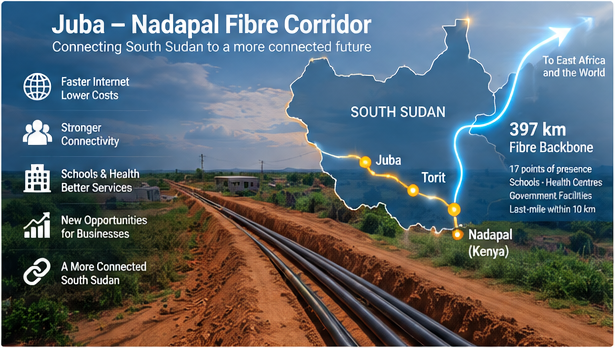
For years, South Sudan’s digital-connectivity problem has been relatively easy to describe: limited terrestrial infrastructure, high costs, weak redundancy and heavy reliance on expensive forms of backhaul.
What has been much harder is moving from plans to physical infrastructure.
That makes the latest procurement by the Ministry of Information, Communication Technology and Postal Services consequential.
Under the World Bank-financed Eastern Africa Regional Digital Integration Project, or EARDIP, the government has invited international competitive bids for approximately 397 kilometres of terrestrial fibre along the Juba–Nadapal route toward the Kenyan border. The procurement is identified as SS-MICT&PS-544330-NC-RFB, financed under World Bank grant E1780, with bids scheduled to close on 26 October 2026.
The long-discussed Kenya-facing fibre connection has advanced from planning and design work into procurement for physical backbone deployment. That is a meaningful milestone — but not yet a completed network.
Why the Kenya corridor matters
A terrestrial connection toward Kenya could give South Sudan another pathway into East Africa’s larger fibre ecosystem.
That matters because international connectivity is not simply about internet speed. It affects wholesale bandwidth costs, network resilience, competition between service providers and ultimately what households and businesses pay.
Available procurement information describes a backbone with at least 17 points of presence, connections for major communities and support for last-mile service to schools, health centres and government facilities within ten kilometres of the route.
A functioning backbone could therefore make locations along the corridor more commercially attractive for local internet distribution.
But there is an important distinction.
A fibre backbone is not the same thing as affordable broadband.
The cable can pass a town without ordinary residents receiving useful service. The real development impact will depend on whether operators can connect to the backbone on reasonable terms and whether investment follows in last-mile infrastructure — the Wi-Fi networks, mobile towers, fixed connections and institutional links that actually bring connectivity to users.
The next question is access
South Sudan should therefore be asking several questions before the first kilometre of fibre is buried.
Who will operate the infrastructure? Will licensed internet service providers receive open and non-discriminatory wholesale access? How will capacity be priced? Where will interconnection occur? What redundancy will exist when fibre is cut? And what incentives will encourage operators to connect communities beyond the most profitable urban locations?
Without clear answers, a publicly financed backbone could improve national infrastructure without producing the level of competition or affordability that consumers expect.
With the right framework, however, the consequences could extend well beyond ordinary internet access.
Schools could obtain reliable connections. Health facilities could use digital services more effectively. Government offices could communicate through secure networks. Businesses could adopt cloud applications, digital payments and remote support systems more easily.
The opportunity may be above the fibre, not underneath it
The procurement requirements illustrate the difference between building national infrastructure and providing services over it.
Available tender information allows bidders to form joint ventures or use licensed subcontractors, and eligible new entrants may participate. Prime bidders, however, are expected to demonstrate substantial technical and financial capacity, including comparable contract experience, annual turnover and access to liquid resources or credit facilities.
That means many smaller South Sudanese technology companies are unlikely to lead the backbone construction contract.
But they do not necessarily need to build the backbone.
They can build on top of it.
A new fibre point can support managed Wi-Fi networks, enterprise internet, VoIP services, call centres, cloud applications, digital-government services, education platforms and other connectivity businesses.
This distinction should influence how South Sudan thinks about local participation. Local digital-sector development should not be measured only by whether South Sudanese companies win construction contracts. It should also be measured by whether the infrastructure creates an environment in which local service companies can emerge and compete.
There is already evidence of institutional demand
Another procurement notice provides a useful market signal.
On 8 September, the United Nations Mission in South Sudan published a procurement opportunity for fibre-based internet service in Juba, with submissions closing on 21 September 2026.
This should not be mistaken for a measurement of the entire South Sudanese telecom market. But it shows that institutional buyers are looking for business-grade, reliable fibre connectivity, not merely inexpensive consumer data.
That creates a potentially important layer of competition in the telecom market: managed enterprise connectivity.
Satellite does not disappear
Fibre expansion should also not be interpreted as the end of satellite connectivity.
South Sudan’s geography makes that unrealistic. Large areas will remain far from terrestrial fibre infrastructure, while businesses and critical institutions may continue to require satellite links as redundancy.
The more plausible future is therefore hybrid: fibre where economically and geographically viable, satellite where terrestrial infrastructure cannot reach — or where backup connectivity is essential.
That combination could be particularly important for rural Wi-Fi, humanitarian operations, government facilities and businesses operating outside major population centres.
From infrastructure project to digital market
The Juba–Nadapal procurement is consequently important for reasons larger than the cable itself.
If successfully implemented, it could become part of the infrastructure on which a new generation of South Sudanese digital services operates.
PLANNED → PROCUREMENT ← CURRENT → AWARDED → UNDER CONSTRUCTION → BORDER INTERCONNECTION → OPERATIONAL → LAST-MILE EXPANSION
There are several stages between procurement and impact: tender, contract award, construction, Kenya interconnection, network operation, wholesale access, last-mile investment and affordable services.
Failure at any of those stages could substantially reduce the project’s benefits.
South Sudan Press therefore considers the procurement a meaningful infrastructure milestone — but not yet a connectivity breakthrough.
The next phase deserves close scrutiny. The most important indicators will be the eventual contract award, construction progress, border interconnection arrangements, wholesale-access rules, pricing, reliability standards and evidence that communities and institutions along the corridor are actually being connected.
Because ultimately, kilometres of fibre are not the measure of digital development.
The measure is what people, institutions and businesses are able to do once the network arrives.
What to watch
For the remainder of 2026, four developments will tell us whether this project is beginning to reshape South Sudan’s telecom market: the 26 October procurement outcome, publication of the operating and open-access model, confirmation of the Kenya-border interconnection arrangements, and evidence that ISPs and other service providers are preparing last-mile investment around the backbone.
Reference notes
- South Sudan government / EARDIP procurement: international competitive procurement for the Juba–Nadapal fibre route, World Bank grant E1780, procurement reference SS-MICT&PS-544330-NC-RFB, bids closing 26 October 2026.
- UNMISS procurement: fibre-based internet service opportunity in Juba published 8 September 2026, closing 21 September 2026.
- Editorial limit: A tender is not a completed network. Contract award, construction, border interconnection, wholesale pricing, operating arrangements and reliability remain unresolved.