
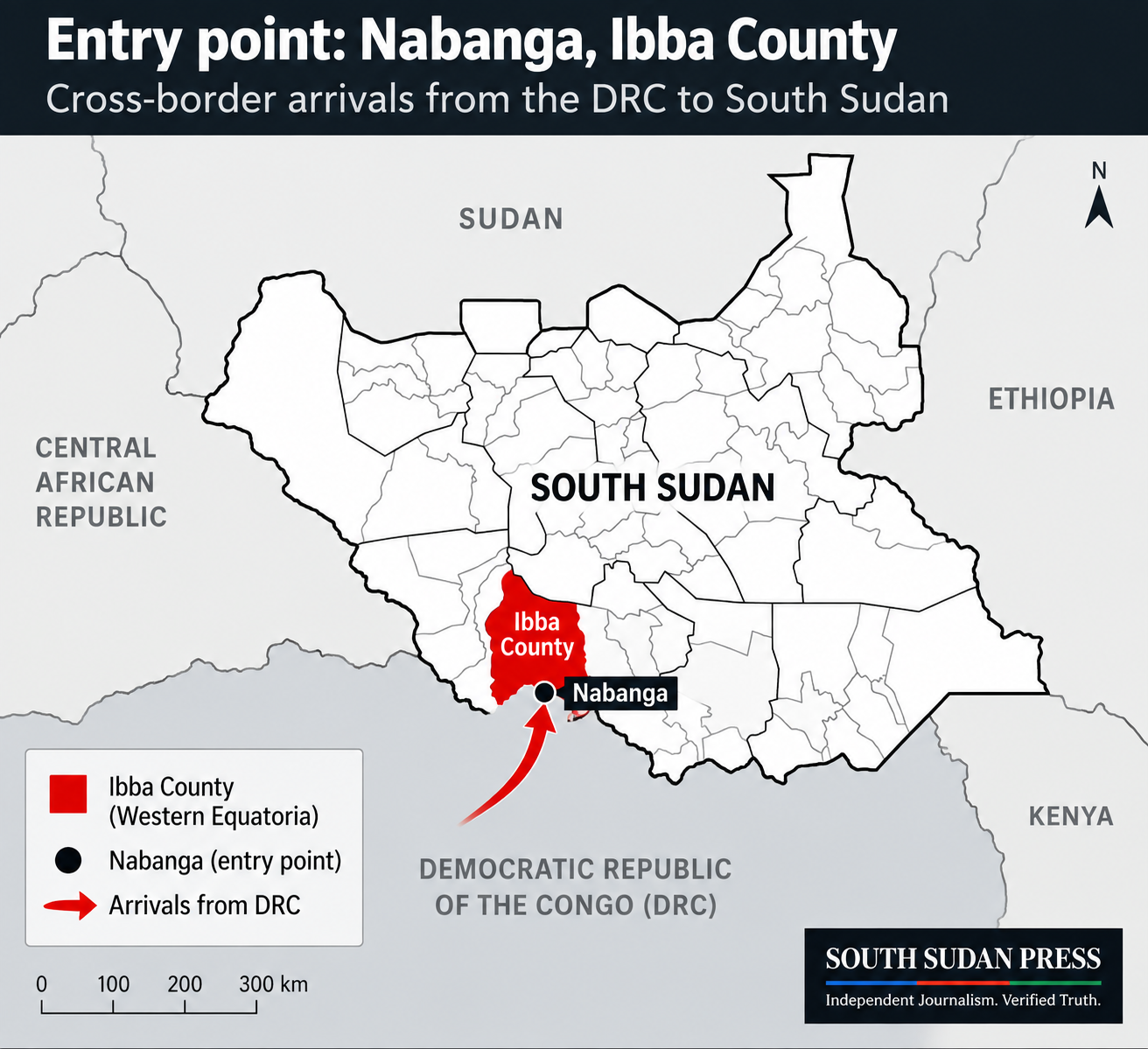
IBBA, WESTERN EQUATORIA — Authorities in Ibba County have registered 3,450 South Sudanese returnees and Congolese nationals at Nabanga after people crossed from the Democratic Republic of the Congo amid concern about the continuing Bundibugyo-virus Ebola outbreak.
The figure, reported by Eye Radio on 18 September, comes from Ibba Relief and Rehabilitation Commission coordinator John Venasio. Officials said the arrivals comprise 575 households and include 1,816 children, 1,603 adults and 31 people with disabilities. A temporary transit site has been allocated and health personnel deployed for screening and monitoring.
What is confirmed — and what is not
No Ebola case has been confirmed among the 3,450 registered arrivals. Authorities have not published how many people have been tested, their results, the health zones in DRC from which individuals originated, quarantine criteria, laboratory turnaround times or the referral pathway for a suspected case.
More than half of the registered arrivals are children
The registration data show 586 children aged 0–4 and 1,230 aged 5–14 — a combined 1,816 children, or about 52.6% of the total registered population. Officials reported another 766 people aged 15–24, 771 aged 25–64 and 66 aged 65 or above. Thirty-one people with disabilities were reported separately.
Registered arrivals reported by Ibba authorities
The available registration figures do not provide a male/female breakdown of all 3,450 people. Officials reported 355 male-headed households and 220 female-headed households, but household-head sex cannot be used to estimate how many men, women, boys or girls are present. South Sudan Press will not manufacture that breakdown.
Can we calculate the chance of Ebola spreading into Nabanga?
No reliable infection probability can currently be calculated from the published information. To estimate the risk quantitatively, health authorities would need to know where each person came from, whether those locations have active transmission, recent exposure histories, symptom status, test results and contacts after arrival.
The DRC-wide case count also cannot be divided by 3,450 to produce an “infection rate” for the Nabanga arrivals. They are not a random sample of the DRC population, and their places of origin have not been published.
WHO reported 7,258 confirmed Bundibugyo-virus disease cases and 3,510 deaths in the DRC as of 13 September, across 62 health zones in seven provinces. Ituri remained the principal focus, while transmission was also increasing or persisting in other affected areas. WHO says the continuing outbreak poses a risk of cross-border spread and has emphasised surveillance and coordination at borders.
How Ebola actually spreads
Ebola is not spread simply because people from an affected country enter a town. WHO says person-to-person infection occurs through direct contact, through broken skin or mucous membranes, with the blood or other body fluids of a person who is sick with Ebola or has died from it, or through objects contaminated with those fluids.
Importantly, WHO states that people do not transmit Ebola before they develop symptoms. The incubation period can range from two to 21 days. That makes symptom monitoring, rapid reporting and safe referral especially important after possible exposure.
| Situation | What it means for transmission |
|---|---|
| Arrival with no infection | No Ebola transmission can originate from that person. |
| Infected but not yet symptomatic | WHO says people are not infectious before symptoms begin; monitoring remains important during the incubation period. |
| Symptomatic Ebola case with rapid isolation and infection-control precautions | Risk can be substantially reduced by avoiding direct contact with body fluids and using appropriate clinical infection-control measures. |
| Symptomatic case with delayed detection and close unprotected contact | Risk rises, particularly for household members, carers and health workers exposed to body fluids or contaminated materials. |
Should South Sudan's health authorities be worried?
They have reason to be alert and prepared, not alarmist. WHO says the outbreak remains active and poses a cross-border risk. A movement of 3,450 people into a border community creates a significant surveillance and humanitarian workload even when no infection has been confirmed.
The public-health test is therefore whether authorities can identify symptoms quickly, investigate relevant travel and exposure histories, safely collect and transport samples when indicated, isolate suspected cases appropriately, protect health workers and arrange rapid referral — while maintaining humane conditions for people who are not sick.
The humanitarian test is equally important. With more than half of the registered population aged under 15, authorities and aid agencies need adequate safe water, sanitation, food, shelter, child protection, family tracing and access to routine healthcare. Overcrowding and poor sanitation can create health risks of their own even in the absence of Ebola.
Isolation must not become stigma
Ibba County Commissioner Wilson Tetela told Eye Radio that authorities wanted the arrivals “isolated” from existing Nabanga residents. That wording requires clarification. It is not yet clear whether officials mean separate temporary accommodation, medical observation, formal quarantine or restrictions on movement.
Those distinctions matter. Treating every person arriving from the DRC as infected would be scientifically unsupported and could discourage people from reporting symptoms or cooperating with surveillance. Public-health measures should be based on symptoms, exposure assessment and established protocols rather than nationality or community identity.
What the public should know
Public-health guidance
Do not assume that a person arriving from the DRC has Ebola. Avoid direct contact with blood, vomit, diarrhoea and other body fluids of anyone who is seriously ill. Do not handle the body of a person suspected of dying from Ebola without trained health personnel. Anyone who develops sudden fever, severe weakness, headache, muscle pain, vomiting or diarrhoea after possible exposure should seek medical advice promptly and tell health workers about recent travel or contact history. Health workers should use appropriate infection-prevention precautions when assessing suspected cases.
The questions authorities now need to answer
South Sudan Press is seeking clarity on the precise DRC origins of the arrivals; how many have been screened and tested; where samples are processed and typical turnaround time; the definition and legal basis of any isolation or quarantine; the designated referral facility; availability of ambulances and protective equipment; water and sanitation capacity at the transit site; food and shelter stocks; the presence of unaccompanied children; and which agencies are financing the response.
Until those details are available, the responsible conclusion is narrow: South Sudan faces a real preparedness challenge at Nabanga, but there is currently no published evidence of an Ebola infection among the 3,450 registered arrivals.