
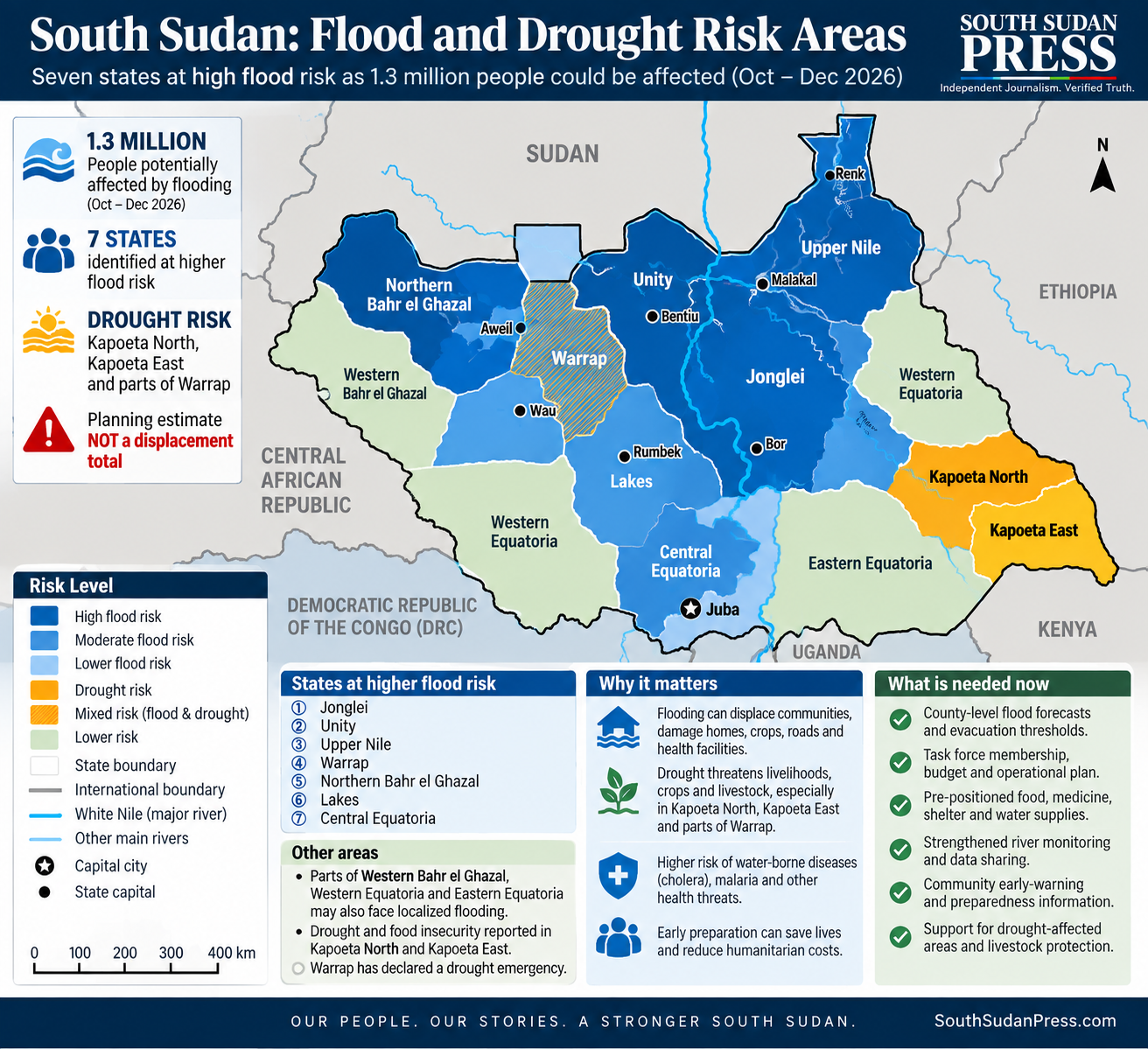
JUBA — South Sudan has activated its National Flood Task Force as authorities prepare for heightened flood and disease risks during the October–December 2026 period, with the government estimating that as many as 1.3 million people could potentially be affected.
Humanitarian Affairs and Disaster Management Undersecretary William Chan identified Jonglei, Unity, Upper Nile, Warrap, Northern Bahr el Ghazal, Lakes and Central Equatoria among areas requiring heightened flood preparedness. The warning was delivered during an IGAD regional preparedness forum, where South Sudan also called for stronger cross-border information sharing on Nile flows and better pre-positioning of relief supplies.
What the 1.3 million figure means
The figure is an official planning estimate of people who could potentially be affected. It is not a count of people already flooded, displaced or evacuated. Authorities have not yet published a county-by-county allocation of the estimate or a public forecast showing expected flood depth and probability for each locality.
Seven states under heightened attention
The warning stretches across a large part of the country. Jonglei, Unity and Upper Nile bring particular concern because recurrent flooding can combine with displacement, food insecurity and difficult humanitarian access. Warrap, Northern Bahr el Ghazal, Lakes and Central Equatoria are also included in the government's preparedness estimate.
The map accompanying this report shows the states named by authorities. It should not be read as a county-level inundation forecast. South Sudan Press will update the map when official county projections, river thresholds or evacuation triggers are published.
Flood in some areas, drought in others
The climate warning is not only about excess water. Chan also identified Kapoeta North and Kapoeta East in Eastern Equatoria as experiencing drought and food insecurity and said Warrap had declared a drought emergency affecting food production.
Separate reporting from Lakes State shows authorities and humanitarian partners preparing an inter-agency assessment of crop failure linked to prolonged dry conditions. This illustrates the central challenge: South Sudan may have to manage flood emergencies in some areas while drought undermines crops, livestock and water availability elsewhere.
Why flooding can become a health and access emergency
Floodwaters can displace communities, damage crops and homes, cut roads, contaminate water sources and make clinics harder to reach. Where food insecurity and displacement are already severe, those impacts can compound quickly.
Health preparedness is therefore part of flood preparedness. Authorities need to plan for safe water, sanitation, malaria prevention, cholera surveillance, medicine stocks, functioning referral routes and continuity of essential health services in communities that may become isolated.
Activation is only the beginning
The creation or activation of a national task force matters only if early warning becomes early action. The government has not yet publicly released, alongside the announcement, a detailed task-force membership list, budget, county-level operational plan or inventory showing exactly where food, medicine, shelter materials, boats and water-treatment supplies have been pre-positioned.
Where and how severe?
What money is released?
Where are supplies?
Who gets alerted?
What happens when thresholds are reached?
The accountability test before October
South Sudan Press will track whether national warnings translate into preparedness at state and county level: which counties account for the 1.3 million estimate; what river or rainfall thresholds trigger action; how much funding has been released; where emergency stocks are positioned; which roads, schools and clinics face the greatest exposure; and whether disease-control preparations are included.
What communities should know
People in flood-prone areas should follow verified state and county warnings, avoid crossing fast-moving floodwater, protect drinking-water sources where possible, keep essential medicines and important documents in safe locations, and seek medical attention promptly for serious diarrhoeal illness or other acute symptoms. Government and humanitarian agencies remain responsible for ensuring warnings are understandable, evacuation routes are practical and assistance can reach isolated communities.
South Sudan knows the risk. Is it ready?
The early warning creates a short but important preparedness window. The country now has a National Flood Task Force, an official estimate of 1.3 million people potentially affected, seven states identified for heightened attention and a period in which supplies and response systems can still be positioned.
The question South Sudan Press will follow is straightforward: will preparedness reach vulnerable communities before the water does?