
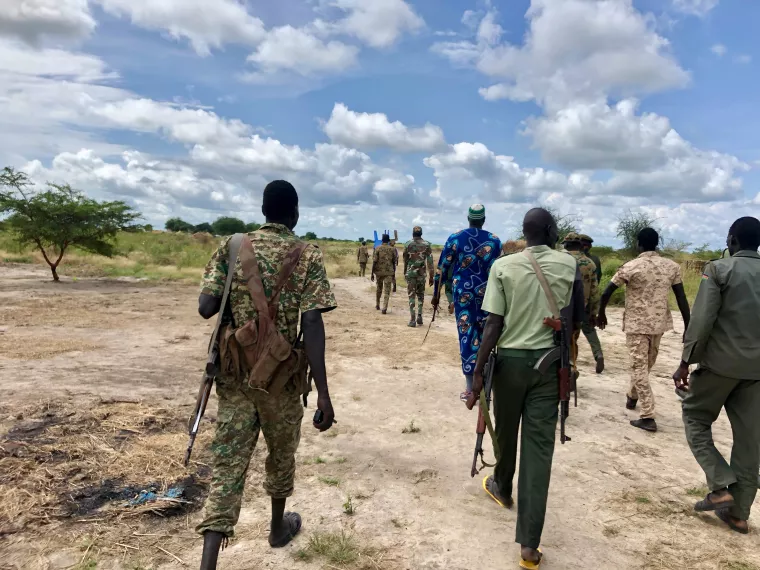
The South Sudan People’s Defence Forces has ordered all Agwelek personnel currently in Juba to report to the Terekeka Assembly Area in Central Equatoria State for screening and integration, with reporting beginning on 15 September 2026.
The directive was announced by SSPDF spokesperson Maj. Gen. Lul Ruai Koang. It also orders Agwelek forces deployed in Greater Tonj, Warrap State, and at Nyakeen in Twic East County, Jonglei State, to remain on standby for screening and integration teams from SSPDF General Headquarters in Bilpam.
The order applies to Agwelek forces under the overall command of Lt. Gen. Johnson Olony Thabo, who currently serves as SSPDF Assistant Chief of Defence Forces for Disarmament and Mobilisation.
The military order and 15 September reporting date are confirmed. But reporting to an assembly area does not mean the force has already been fully integrated, disbanded or absorbed into a unified command structure.
What the order does not say
The publicly reported directive does not specify the number of personnel expected to report, the screening and eligibility criteria, the timetable for completing integration, how ranks will be harmonised, where accepted personnel will ultimately be deployed, or what will happen to applicants who do not qualify.
It also does not publicly set out procedures for weapons registration, biometric enrolment, payroll verification or the treatment of duplicate names and other personnel-record discrepancies.
South Sudan Press has not independently verified that Agwelek personnel have begun arriving at the Terekeka Assembly Area. That will be an important test of implementation after the reporting date takes effect.
Why the process matters
Agwelek is an Upper Nile-based armed formation historically commanded by Olony. The group signed the 2022 Khartoum arrangements with the government, which included commitments related to ceasefire and integration into the national army.
The formation has historically been associated predominantly with members of the Chollo, also known as Shilluk, community in Upper Nile. That background should not be taken to mean that Agwelek represents the Chollo community as a whole, or that the community and the armed formation are interchangeable.
Security-force unification and integration have remained among the most difficult parts of South Sudan’s wider peace implementation. Screening can help establish who is eligible to enter the national force, clarify command structures and improve personnel and payroll accountability.
But integration can also become contentious when there are disagreements over force numbers, military ranks, salaries, weapons, deployment or exclusion from the final force.
Forces already deployed outside Upper Nile
The inclusion of Agwelek personnel deployed in Greater Tonj and Twic East gives the order an immediate operational dimension. Those forces are not simply waiting in cantonment areas; some have been deployed in locations affected by security and civilian-protection concerns.
That makes command transition important. Authorities will need to clarify who retains operational responsibility during screening, whether existing deployments continue, and how security gaps will be avoided if personnel are moved or reorganised.
ORDER ISSUED ✓ → REPORTING / ASSEMBLY ← CURRENT → SCREENING → VERIFICATION → RANK & PAYROLL HARMONISATION → DEPLOYMENT → FULL INTEGRATION
What happens next
The first measurable question is straightforward: how many personnel actually report?
Beyond attendance, the credibility of the process will depend on whether the SSPDF publishes or clearly communicates eligibility standards, verifies personnel identities, reconciles ranks and payroll records, registers weapons and explains what happens to those who fail screening.
How many Agwelek personnel are on the official list, and how many report for screening? Does Lt. Gen. Johnson Olony retain operational control during and after the process? What happens to rejected personnel? How will weapons be registered? Where will integrated personnel be deployed? Are CTSAMVM, RJMEC, UNMISS or other peace-monitoring institutions observing the process? And how will communities in Upper Nile, Greater Tonj and Twic East be protected during any command transition?
Until those questions are answered, the 15 September directive should be understood as the beginning of another stage in the integration process — not evidence that integration has already been completed.
Source notes
Eye Radio: reported the SSPDF order, 15 September reporting date, standby instructions for forces in Greater Tonj and Twic East, and the connection to the 2022 agreement.
Sudans Post: reproduced substantial portions of the military directive and reported that the order applies to Agwelek forces under Lt. Gen. Johnson Olony Thabo.
Editorial limit: Personnel totals, screening criteria, rank and payroll procedures, weapons registration, final deployment and verified arrivals were not publicly established in the material reviewed at publication time.