
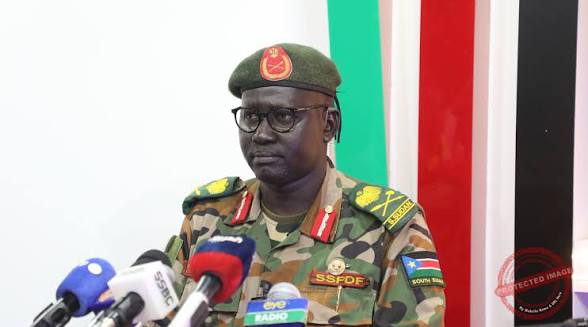
JUBA/NYIROL — The South Sudan People’s Defence Forces has ordered Lou-Nuer groups awaiting integration into the army and other organised forces around Waat and Lankien in Nyirol County, Jonglei State, to report to designated assembly areas within 72 hours.
In an original video statement obtained and reviewed by South Sudan Press, SSPDF spokesperson Maj. Gen. Lul Ruai Koang said the order was issued by Chief of Defence Forces Gen. Santino Deng Wol. He said forces deployed at outposts around Waat must report to the Waat Assembly Area, while those around Lankien must report to the corresponding assembly area. The recording confirms the substance of Eye Radio’s 18 September report.
The SSPDF said the reporting is intended to take place ahead of the arrival of a screening and integration committee. Lul described the directive as “clear orders for execution.” The statement did not specify when the committee would arrive or how many personnel were expected to report.
Editorial status
DEVELOPING · 72-HOUR ASSEMBLY ORDER · SCREENING PENDING · ARRIVALS NOT YET VERIFIED · INTEGRATION NOT YET ESTABLISHED
Who exactly is covered?
Eye Radio described those affected as Lou-Nuer groups awaiting integration into the SSPDF and other organised forces. The available public statement does not identify individual formations or commanders.
South Sudan Press has not independently established that the directive includes White Army elements, former SPLA-IO personnel or any other specific formation. The order should therefore not be interpreted as applying to the Lou Nuer population generally.
Nor does an instruction to report to an assembly area establish that personnel have accepted government command, surrendered weapons or completed integration. Those distinctions will be important as the reporting period unfolds.
What happens at Waat and Lankien?
Several operational questions remain unanswered. The military has not publicly detailed the screening criteria, how weapons will be registered or controlled, which national services successful personnel could enter, what happens to personnel who fail screening or decline to report, or whether peace-agreement monitors will observe the process.
The precise expiry of the 72-hour period depends on when the directive formally took effect. South Sudan Press is therefore not assigning an exact deadline hour until that has been established.
Nyirol was previously labelled a ‘hostile’ county
The directive also carries sensitive historical context.
In April 2025, Cabinet Affairs Minister Dr. Martin Elia Lomuro publicly categorised a number of Nuer-majority counties as either “hostile” or “friendly” to the government. Contemporary reporting by Radio Tamazuj recorded Nyirol among the counties Lomuro described as “hostile”, alongside Nasir, Ulang, Akobo, Uror, Fangak, Ayod, Rubkona and Panyijiar.
The remarks generated significant controversy, including accusations of ethnic profiling from Nuer community leaders. The government subsequently sought to clarify the remarks. Youth and Sports Minister Joseph Geng Akech said the description was intended to refer to organised armed groups rather than the Nuer community collectively.
There is currently no evidence establishing that Lomuro’s April 2025 remarks caused or determined the present SSPDF assembly order. South Sudan Press is not suggesting such a connection. The earlier controversy nevertheless demonstrates why precise distinctions between communities, political organisations and armed formations are important when reporting security operations in Nyirol.
Part of a broader integration push?
The Nyirol directive follows another recent SSPDF screening order involving Agwelek personnel. The similarity raises a question about whether authorities are accelerating screening and integration activity, but the two directives alone are insufficient to establish a coordinated nationwide programme.
For Nyirol, implementation will be the key measure: how many personnel arrive, which formations they represent, whether commanders participate, how weapons are handled, whether screening follows agreed security arrangements and what safeguards are provided for surrounding civilians.
The peace-agreement question
The development comes as regional attention returns to implementation of the 2018 Revitalised Peace Agreement. On 15 September, IGAD’s Council of Ministers reaffirmed the agreement as the “sole viable framework for peace” and called for sustainable and predictable resources for RJMEC and CTSAMVM through the remainder of the Transitional Period.
That makes the role of authorised peace-monitoring institutions in security-force integration an important question. South Sudan Press will seek clarification on whether CTSAMVM, RJMEC or other authorised monitors will observe the Waat and Lankien process.
What SSP will watch over the next 72 hours
There is also a civilian-protection dimension. Concentrating armed personnel around Waat and Lankien could affect markets, transport, humanitarian operations and local movement. Any such effects will need to be established separately rather than assumed.
For now, the confirmed development is limited but significant: the SSPDF has issued the order. Screening has not yet been demonstrated to have occurred, and successful integration has not yet been established.