Community Defence and Armed Groups: What the Evidence Can Establish
Selected documented formations, not an exhaustive national census or a current deployment map. Groups do not represent entire ethnic communities. No comparable verified current headcounts were established; blank evidence must not be converted into estimates or a ranking of fighting strength. State forces and party armies are not interchangeable with community defence networks.
Download the comparison chart (PNG) →
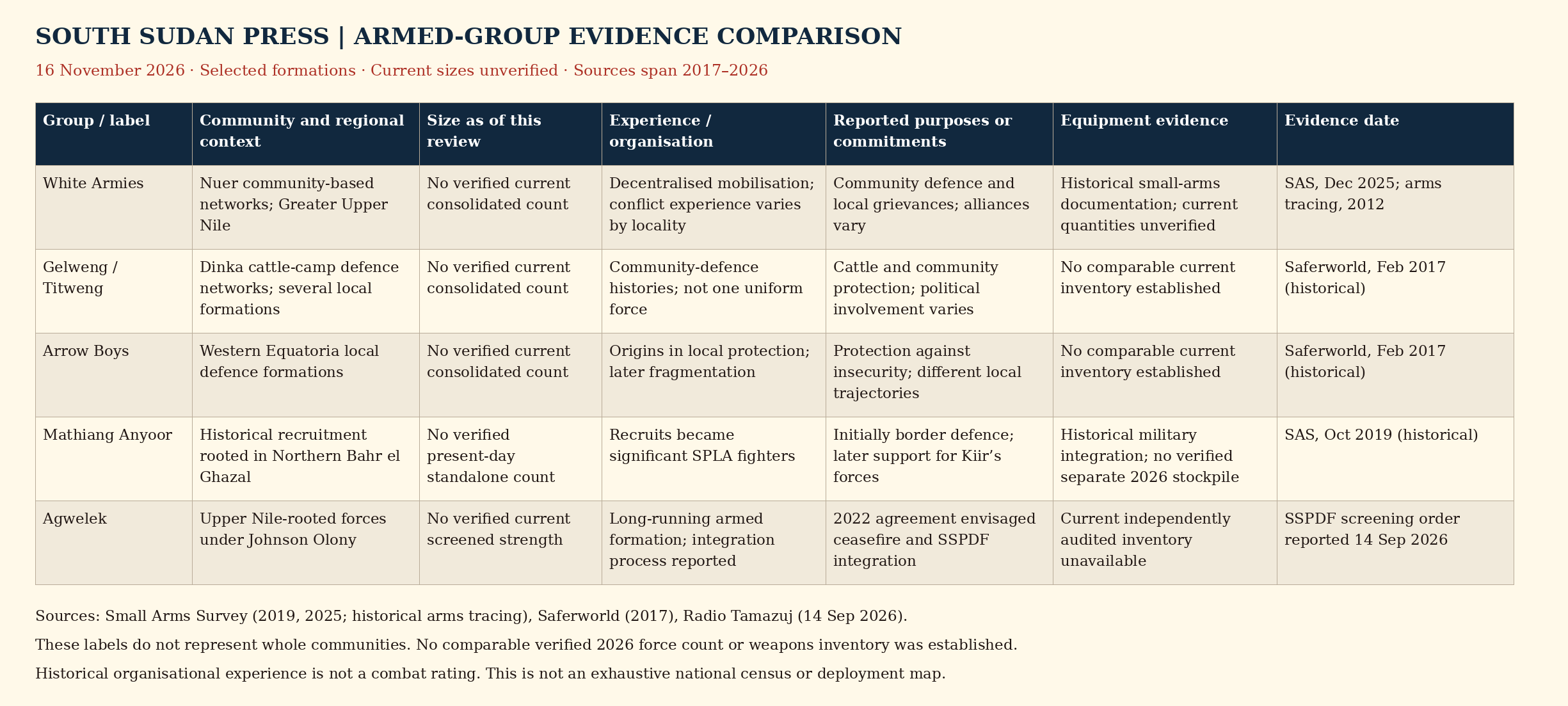
| Group / label | Community and regional context | Size as of this review | Experience / organisation | Reported purposes or commitments | Equipment evidence | Evidence date |
|---|---|---|---|---|---|---|
| White Armies | Nuer community-based networks; Greater Upper Nile | No verified current consolidated count | Decentralised mobilisation; conflict experience varies by locality | Community defence and local grievances; alliances vary | Historical small-arms documentation; current quantities unverified | SAS, Dec 2025; arms tracing, 2012 |
| Gelweng / Titweng | Dinka cattle-camp defence networks; several local formations | No verified current consolidated count | Community-defence histories; not one uniform force | Cattle and community protection; political involvement varies | No comparable current inventory established | Saferworld, Feb 2017 (historical) |
| Arrow Boys | Western Equatoria local defence formations | No verified current consolidated count | Origins in local protection; later fragmentation | Protection against insecurity; different local trajectories | No comparable current inventory established | Saferworld, Feb 2017 (historical) |
| Mathiang Anyoor | Historical recruitment rooted in Northern Bahr el Ghazal | No verified present-day standalone count | Recruits became significant SPLA fighters | Initially border defence; later support for Kiir’s forces | Historical military integration; no verified separate 2026 stockpile | SAS, Oct 2019 (historical) |
| Agwelek | Upper Nile-rooted forces under Johnson Olony | No verified current screened strength | Long-running armed formation; integration process reported | 2022 agreement envisaged ceasefire and SSPDF integration | Current independently audited inventory unavailable | SSPDF screening order reported 14 Sep 2026 |
Small Arms Survey’s historical tracing work documents rifles, machine guns and other small arms among regional armed actors. It does not establish today’s holdings for every group above. This chart therefore avoids assigning weapons or quantities without group-specific evidence. “Experience” describes documented organisational history, not a measured combat rating.
Source dates differ substantially. Older reports explain origins and evolution; their descriptions should not be read as a November 2026 order of battle. Force size can change through mobilisation, demobilisation, integration and fragmentation. A useful future update would require independently checked rosters and clearly dated methods.
Sources and evidence
- Small Arms Survey: White Armies, December 2025
- Saferworld: Informal Armies, February 2017
- Small Arms Survey: Mathiang Anyoor, October 2019
- Radio Tamazuj: Agwelek screening, 14 September 2026
- Small Arms Survey: historical arms tracing
Prepared from published sources. No original SSP interviews or reporting requests are claimed. Operational outcomes may change; this is not a live update feed.