TUESDAY · 2 NOVEMBER 2026 · ANALYSIS
Beyond the Camps: What Safe, Voluntary Return Actually Requires
Diaspora support and international advocacy should expand displaced people’s choices, not pressure families to leave before conditions are ready.
The question is not simply how to move people out of camps. It is how families can rebuild secure lives with a real choice about where to live. For South Sudanese displaced inside their own country, return or local integration is generally the appropriate language; repatriation refers to crossing an international border back to one’s country.
Nor are all places commonly called UN camps identical. A UN Upper Nile factsheet says the former Malakal Protection of Civilians site was redesignated an IDP settlement in February 2026. A change in designation does not establish that a family’s security, land or service needs have been resolved.
South Sudan’s durable-solutions framework supports voluntary return, local integration and settlement elsewhere. The UN describes practical work on land, shelter, documentation, livelihoods and peacebuilding. These are foundations for durable choices; transporting a household is only one component.
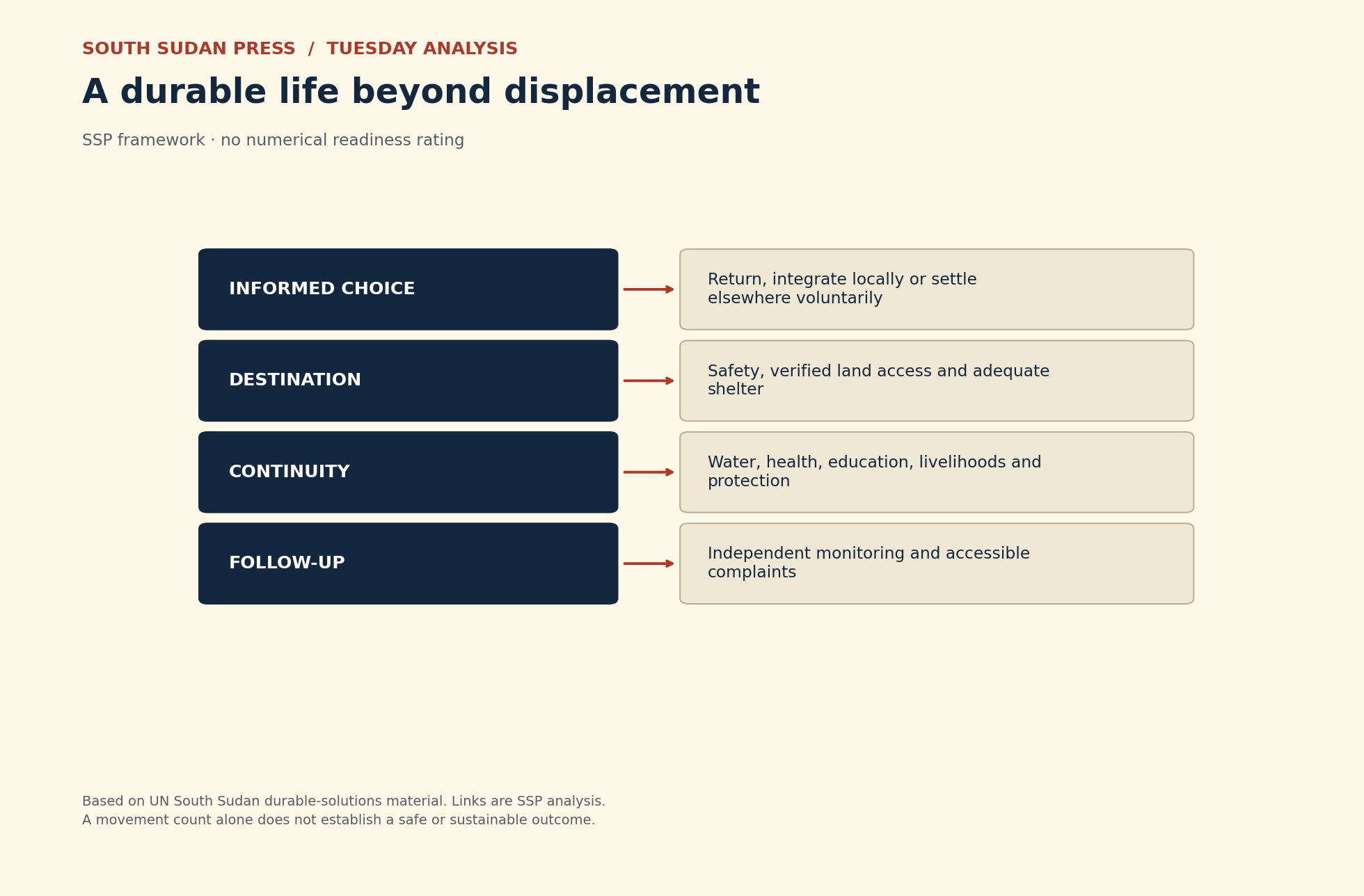
The first test is informed consent. Families need credible information about security, housing, land access and services, including an opportunity to ask questions privately. Assistance should not be made conditional on endorsing a political position or leaving a site. Nor should diminishing aid be treated as evidence that a return decision is freely chosen.
The second test is the destination. A safe route is not enough if a home is occupied, land is disputed or a clinic and water point cannot function. A workable plan needs land verification and dispute resolution, shelter, schooling, health care and livelihoods. Host communities also need support so that returning families are not set against neighbours competing for scarce services.
The diaspora can contribute through accountable community projects, professional mentoring, business links and support to trusted legal or housing programmes. It should avoid collecting or circulating people’s sensitive identities and locations without consent. Funding should follow assessed needs and the priorities expressed by displaced families, rather than a donor’s preference for a visible convoy or ceremony.
International partners can provide multi-year funding linking immediate protection to recovery. The October IOM warning about a prospective funding gap for Bentiu and Malakal services illustrates why essential assistance must continue while longer-term options are built. It is a warning issued on 9 October, not confirmation here that services have stopped or that later funding has not arrived.
Lobbyists and advocates can seek published budgets, independent protection monitoring, transparent land processes and representation for displaced people in decisions. They can press authorities and donors to remove obstacles to a dignified life. They cannot legitimately substitute their wishes for a household’s own decision to return, integrate locally or move elsewhere.
Success should be assessed after movement: whether people remain safe, retain access to land and livelihoods, use services and can raise complaints without retaliation. A lower camp population can reflect progress, pressure or fresh displacement; the number alone cannot distinguish them.
The accompanying diagram is therefore a framework for questions rather than a numerical readiness score. Consent, destination conditions, sustained services and post-move monitoring need to be considered together. A dignified solution is a durable life, not simply an emptied site.
Sources and verification
- UN in South Sudan · Upper Nile factsheet, April 2026
- UN in South Sudan · Durable Solutions Hub
- IOM · UN Geneva briefing, 9 October 2026
Prepared for 3 November 2026. Allegations and reporting gaps are identified in the text. No new SSP interview or field visit is claimed. Follow-up questions have not been sent as requests.
Tuesday front page → · Jobs & Careers → · Election information →