ANALYSIS · SECURITY AND PARTICIPATION · TUESDAY, 10 NOVEMBER 2026
Election Readiness Must Be Tested on the Journey to the Centre
Staff training matters, but credible access also depends on safe movement, consistent instructions and a way to correct problems.
South Sudan Press · Analysis & data desk
Election preparation is often described through visible administrative milestones: a delivery, an appointment or a workshop. The more demanding question is whether a citizen can actually use the resulting service.
Western Equatoria’s officer induction and the reported attack on the Yambio–Tambura road illustrate why logistics and public safety must be examined together. They do not establish that a particular electoral centre has closed or that the attack was election-related. Neither conclusion is supported by the reviewed reporting.
The connection is a planning question: an election system depends on movement by officials, supplies, observers and citizens. A trained officer cannot deliver an accessible service if the journey to the centre is unsafe or if essential materials remain elsewhere.
Examine the complete service chain
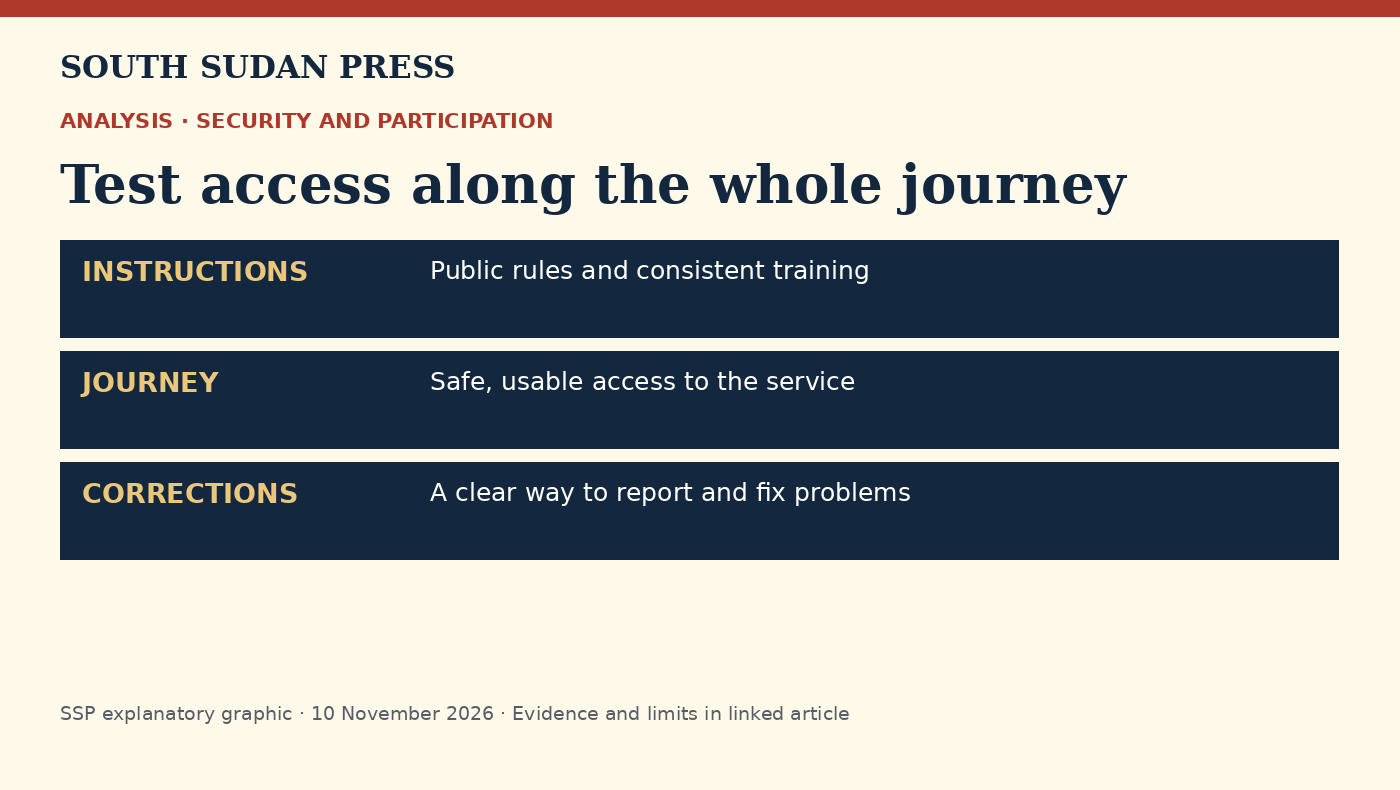
Readiness should be documented from instruction to participation. Are the rules public? Do staff understand them? Has the centre received its allocation? Can people reach the location and obtain assistance without an unofficial fee or a personal intermediary?
Each stage needs evidence suited to the question. A signed receipt shows custody of materials. A training record shows attendance and, if properly designed, competence. A site inspection can test physical accessibility. None alone demonstrates the entire system works.
The accompanying matrix proposes checks rather than awarding invented readiness scores. Its purpose is to make a claim of progress testable and identify which institution can answer when something fails.
Safety information must remain current
General assurances should not be treated as a route-specific security assessment. Authorities need a way to tell the public when circumstances change and how to obtain a reliable update. Such information should be available beyond social media, including through appropriate local broadcasting and notices.
That process must avoid exposing individuals. Publishing detailed staff movements or personal travel plans can create risks. Public communication should provide usable service information while keeping sensitive operational details appropriately protected.
Uncertainty also needs an honest response. Where a committee cannot confirm whether a centre can operate, it should say what remains unresolved and when the next update is expected. Silence transfers the cost of uncertainty to households deciding whether to spend time and money travelling.
Complaints are a readiness tool
A practical complaints system is part of delivery, not an administrative extra. It can reveal inconsistent instructions, inaccessible premises, misconduct or a service that exists on a list but not at the named location.
The system needs a clear receiving office, a record of the complaint and a reasonable response process. Citizens should know whether they are seeking clarification, challenging an administrative decision or reporting a security incident, because those routes may involve different responsibilities.
Independent observation and journalism can test official claims against experience. They should record both successful delivery and documented failures, giving institutions an opportunity to respond without presenting an assurance as proof that a problem has been resolved.
Keep the public purpose visible
The aim is not to dismiss preparation that has occurred. It is to establish whether each improvement contributes to participation under consistent rules. A credible process can demonstrate its progress and acknowledge its remaining gaps.
That requires a shift from counting activities to testing access. The citizen’s journey—from hearing an announcement to obtaining a service and correcting an error—is where administrative readiness acquires public meaning.
Readiness questions that can be tested
| Stage | Evidence to request | Public-interest test |
|---|---|---|
| Rules | Dated NEC notice and clear requirements | Can people understand where and when to attend? |
| Personnel | Training and deployment records | Are consistent procedures used? |
| Materials | Dispatch and receipt records | Can each centre provide the service? |
| Access | Site assessment and current local information | Can eligible citizens reach and use the centre? |
| Complaints | Named receiving office and response process | Can an error be corrected? |
Proposed assessment framework; not an independently scored readiness survey.
Sources and reporting note
- https://www.radiotamazuj.org/en/news/article/western-equatoria-prepares-election-officials-for-polls
- https://www.radiotamazuj.org/en/news/article/child-killed-in-attack-on-vehicles-along-yambio-tambura-road
- https://nec.gov.ss/
Prepared from linked published reporting and primary sources. Analysis and proposed actions are identified as such. SSP does not claim to have conducted interviews or sent requests for this edition. Estimates and disputed claims retain their stated limitations.
Tuesday’s analyses and commentary
Election Readiness Must Be Tested on the Journey to the Centre
Solar Investment Should Be Judged by Services That Keep Working
ADVERTISEMENT · CYBERPASS ACADEMY

Online learning planned from early 2027. Visit www.CyberPass.co for announcements. Course dates, fees and enrolment details to be announced.
ADVERTISEMENT · WEB SERVICES & DOMAIN NAMES

Build a home online for your business, school, NGO or charity. Ask about hosting, website development and selected short four-letter domain names, including names beginning or ending with SS.
Short. Memorable. Easy to say on radio. Each name is subject to availability and individual pricing.