SUNDAY · 1 NOVEMBER 2026 · ANALYSIS
Election Readiness: Why Civil Society Is Challenging the Timetable
With 51 calendar days from 1 November to the announced 22 December poll, the dispute is about demonstrable safeguards as well as a date.
The civil-society challenge to South Sudan’s election preparations is best understood as a demand for credible conditions and public evidence. Treating it as a simple refusal to let people vote misses the argument. The South Sudan Civil Society Forum says the remaining timeframe and outstanding preparations do not support fair, peaceful and inclusive elections.
Eye Radio’s account of the Forum’s 28 October statement identifies concerns about registration, civic education, nominations, materials and logistics, alongside restricted civic space and insecurity. The Forum called for an inclusive dialogue and a roadmap with responsibilities, costs and dates. That is the position of this coalition, not proof that every civil-society organisation holds an identical view.
RJMEC’s third-quarter assessment raises a related but distinct concern: the political and legal pathway to elections lacks sufficient consensus. Its objections to changes in the peace framework are the monitoring body’s assessment, not a substitute for a court judgment. Operational preparation and political legitimacy overlap, but solving one does not automatically settle the other.
As of the edition date, 51 calendar days separate 1 November and the announced 22 December poll. That arithmetic measures time available; it does not measure the percentage of preparations completed. Nor does the absence of a document in the material reviewed by SSP prove that no work has taken place. The relevant test is whether institutions can publish evidence that voters, contestants and observers can examine.
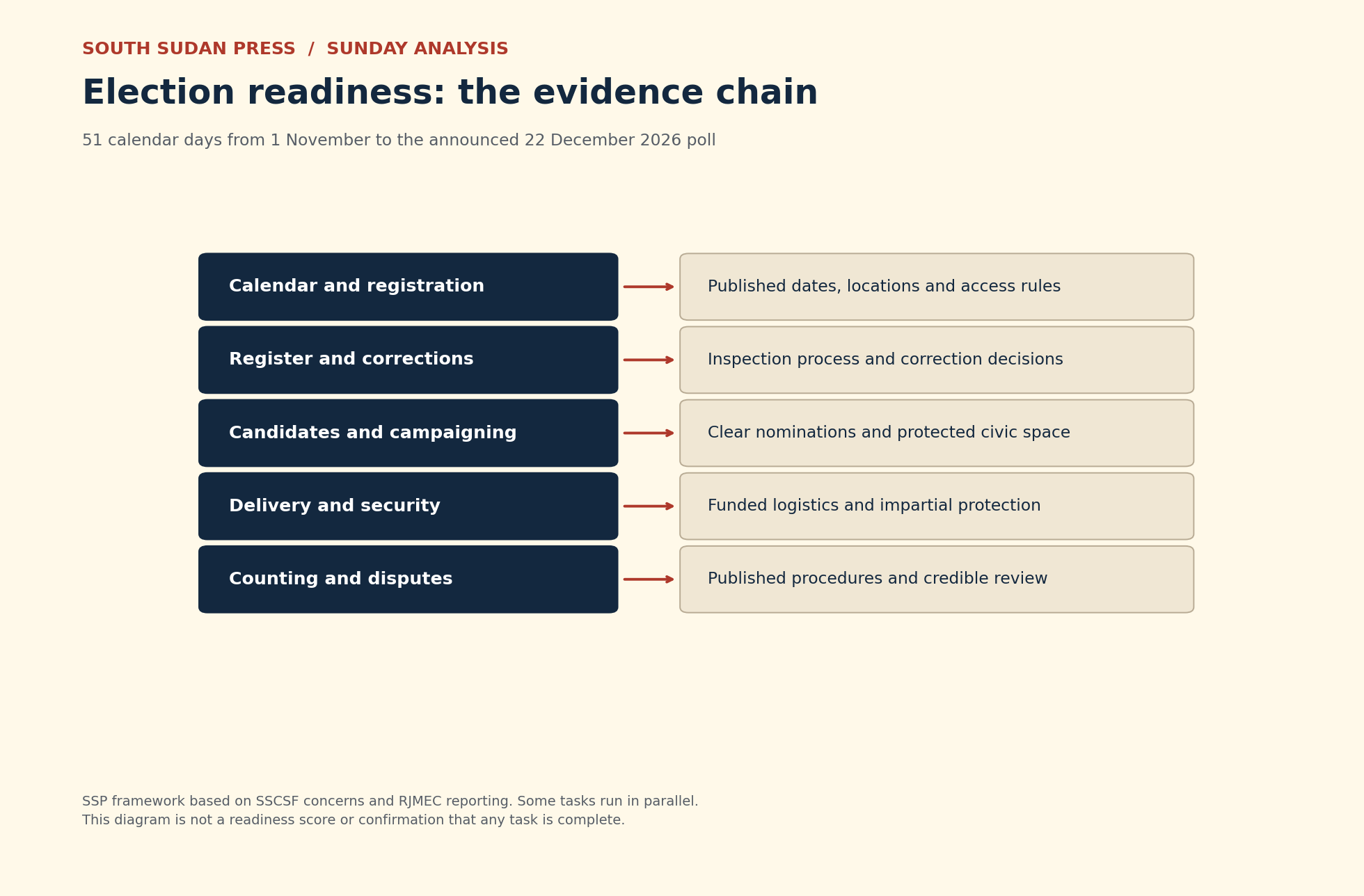
The accompanying chart therefore sets out a sequence of evidence rather than a readiness score. An accessible calendar should lead to registration arrangements, an inspectable register and corrections, clear nomination rules, logistics and security plans, and credible arrangements for counting and disputes. Some tasks can run in parallel, but each needs a named institution, a funded plan and a usable public notice.
Civil-society resistance becomes constructive when it specifies which safeguards are missing, what would satisfy them and how progress can be independently checked. Government and electoral authorities can answer by publishing documents and demonstrating implementation. Describing critics as enemies of elections would leave those practical questions unanswered.
A dialogue should also address people displaced within South Sudan and refugees outside it: where they can register, what documentation is accepted and how complaints are resolved. These are inclusion tests, not assumptions that a particular voting mechanism has already been authorized.
The conclusion is conditional. A credible process requires both enforceable rules and visible delivery. A postponement without a binding roadmap can perpetuate uncertainty; a poll without essential safeguards can produce a result that large parts of the public do not trust. The task is to establish which preparations can genuinely be completed and independently verified, then make the political decision on that evidence.
Sources and evidence
Sources reviewed for the Sunday edition. Dates in the text refer to the underlying reports or observations. Proposed follow-ups are reporting priorities, not claims that requests have been sent.