SUNDAY · 1 NOVEMBER 2026 · BOOK COMMENTARY
The Illusion of Power in Juba: Consent, Memory and Accountability
Three passages from Changkouth Bouth’s book frame a Sunday reflection on institutions and political trust.
Changkouth Bouth’s The Illusion of Power in Juba: A Political History of South Sudan asks readers to judge power by what it delivers and the limits placed on it. For Sunday’s edition, three short passages offer a way to discuss current disputes without pretending that a book proves the facts of a new case.
Disclosure: This feature was requested by SSP’s publisher, who is the book’s author. It is commentary on his work, not an independent review. Quotations have been checked against the supplied 28-page PDF dated 31 August 2026. Page references below refer to that PDF, whose pagination may differ from other editions.
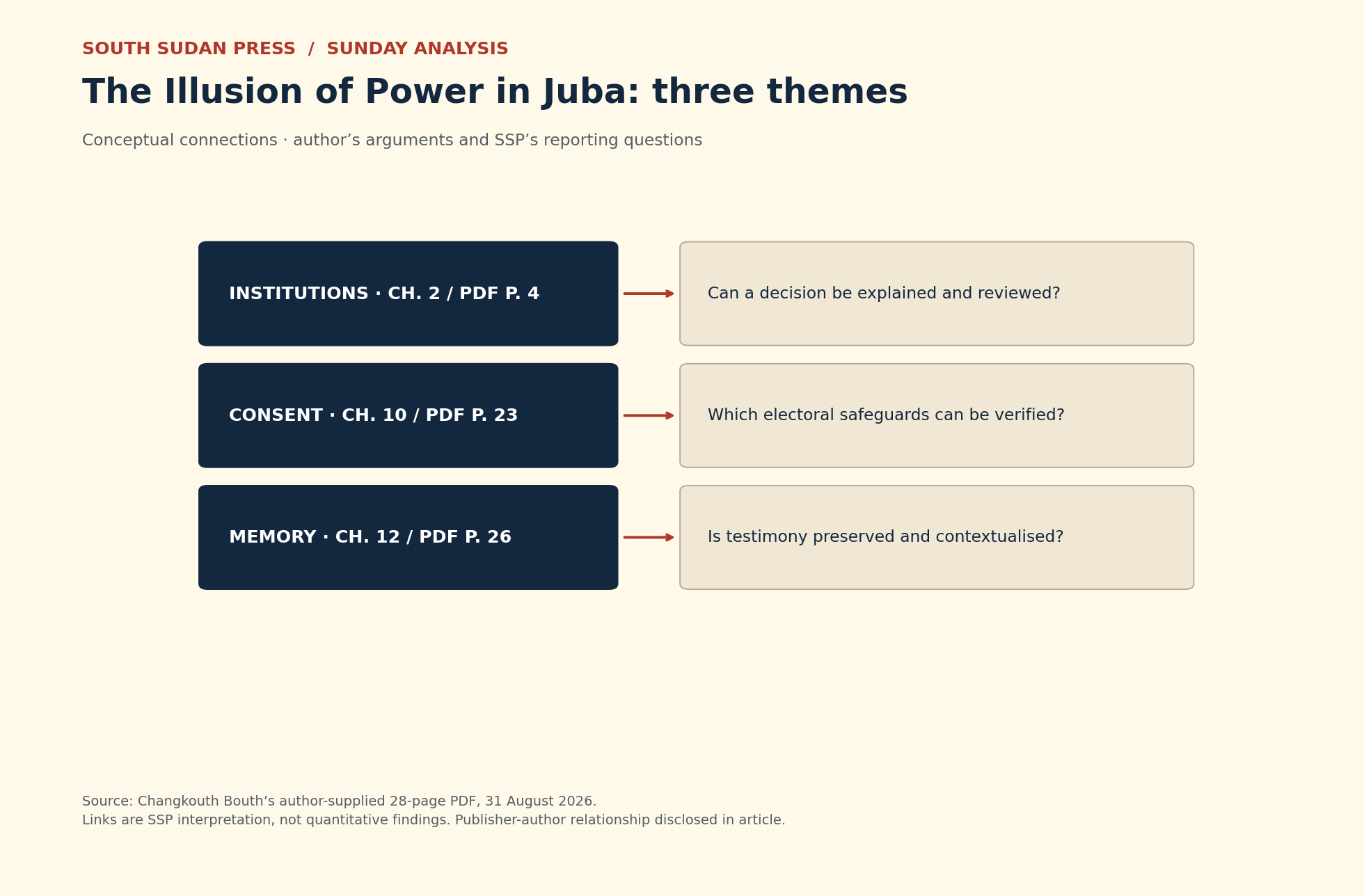
1. Institutions and party authority. In Chapter 2, page 4, Bouth writes: “The SPLM never completed its transformation into a civilian political party. Internal democracy remained weak. Decision-making narrowed around the presidency.” This is the author’s historical and political assessment. It offers a question for contemporary reporting: can a member identify the rule governing a decision and obtain a fair review when it is challenged?
That question is relevant to the Lam Both dispute, but the quotation does not establish the motives of any person involved. Applying the book responsibly means looking for documentary tests: selection criteria, a recorded decision, reasons and a route of appeal. A broad interpretation of political history must not be used to skip those steps.
2. Delay and public consent. Chapter 10, page 23, states: “Power became permanent by default.” The sentence is a compact expression of the author’s criticism of repeated electoral delay. Its force lies in the question of who remains accountable while a transition continues.
The passage can challenge two convenient positions at once. Announcing a polling date does not establish that conditions for meaningful consent exist. Equally, identifying genuine obstacles does not justify an indefinite extension without milestones. The public needs an explanation of which tasks are essential, who must complete them and what evidence will show that they have been completed. This is SSP’s application of the book’s argument, not an additional quotation.
3. Memory and the public record. Chapter 12, page 26, says: “When institutions fail, memory becomes the archive. When courts are silent, memory becomes testimony.” The passage recognises the importance of preserving accounts when formal systems do not provide a trusted record.
For journalism, preservation and verification are complementary duties. A recorded grievance matters because it captures what a speaker said. It still needs context, authentication where possible, a distinction between observation and interpretation, and an opportunity for those accused to respond. The same care is owed to witnesses of humanitarian harm, whose safety and dignity should guide publication.
The accompanying conceptual chart links these themes to reporting tasks: institutional authority to written reasons; public consent to verifiable electoral safeguards; and memory to preserved, contextualised testimony. It contains no numerical index and makes no claim that a quotation is a measured social outcome.
Read together, the selected passages invite a demanding definition of public service: authority should be explainable, participation should be meaningful and the record should remain open to scrutiny. Readers may agree or disagree with the author’s wider account. These excerpts provide a starting point for that discussion while leaving the verification of today’s events to evidence.
Sources and evidence
- Changkouth Bouth · author-supplied book PDF, 31 August 2026; Chapters 2, 10 and 12; PDF pages 4, 23 and 26
Sources reviewed for the Sunday edition. Dates in the text refer to the underlying reports or observations. Proposed follow-ups are reporting priorities, not claims that requests have been sent.