SATURDAY, 31 OCTOBER 2026 · ANALYSIS
The Oil Partnership’s Real Test Is Public Value, Not the Signing Ceremony
Nilepet’s prospective Russian relationship needs transparent terms, enforceable responsibilities and a route to public revenue.
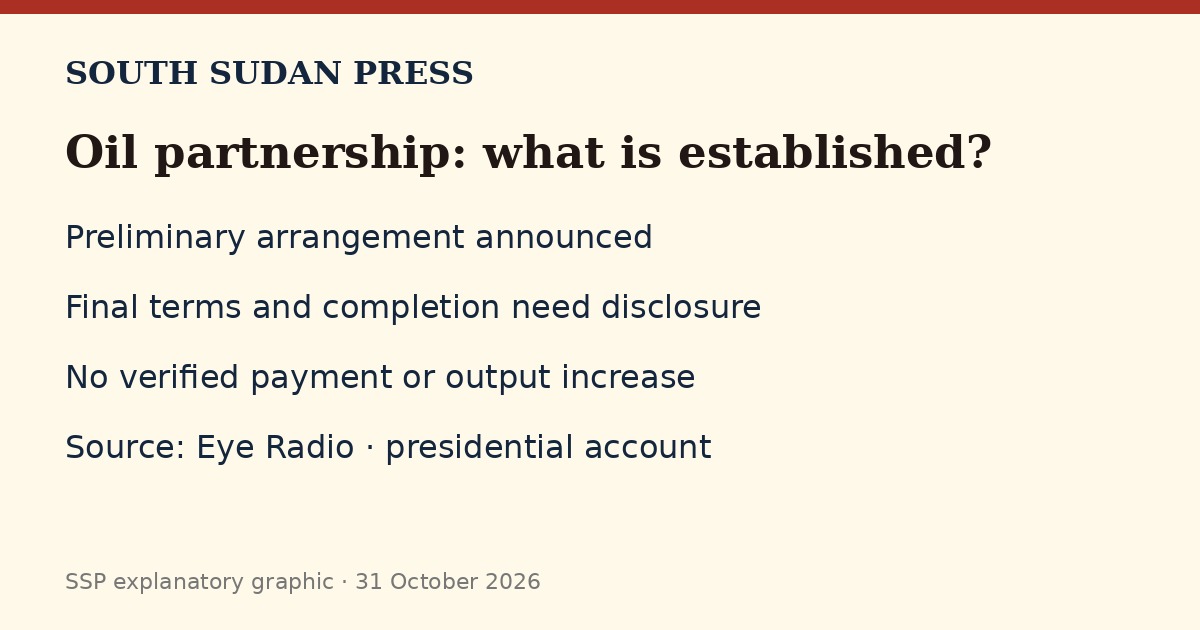
A prospective oil partner can bring technical capacity and finance. The public value of the arrangement depends on the terms, the obligations accepted and the benefits that can actually be checked. A signing ceremony is the beginning of that assessment.
The announced preliminary arrangement with Zarubezhneft leaves a distinction that should remain visible: an intended transfer is not a verified completion. No public valuation, executed transaction record or confirmed payment was obtained for this edition. Predictions of immediate budget relief would therefore outrun the evidence.
For Nilepet, a useful disclosure would explain its precise role. Is it acting as shareholder, participant in negotiations, operator, or a combination established by the final documents? These responsibilities should not be assumed from attendance at a meeting. Each involves different questions about authority, risk and accountability.
The first public-value test is financial. What assets and obligations are involved, how are they valued and where would payments be recorded? An agreement can appear attractive while leaving important costs elsewhere. The documents must show the comparison rather than invite readers to infer it from an announced partnership.
The second test is operational. A commitment to raise production needs an investment plan, defined responsibilities and milestones. Output also has to be transported and sold; a new partner does not automatically resolve every constraint in the chain. This analysis offers no unsupported production or revenue forecast.
The third test concerns communities and workers. Environmental responsibilities, local procurement and training should have measurable obligations and a way to report non-performance. The recent environmental discussion at Nilepet makes those questions particularly relevant, without establishing liability for a particular incident.
The final test is whether commercial performance produces a visible public benefit. That requires a traceable route from receipts to the budget and from budget releases to services. A transparent agreement cannot guarantee success, but secrecy makes success harder to measure. The strongest case for the partnership will be made by published terms and delivered results.
Sources and reporting basis
Prepared from available material for this edition. Follow-up questions identify reporting priorities; they have not been sent as requests by SSP.