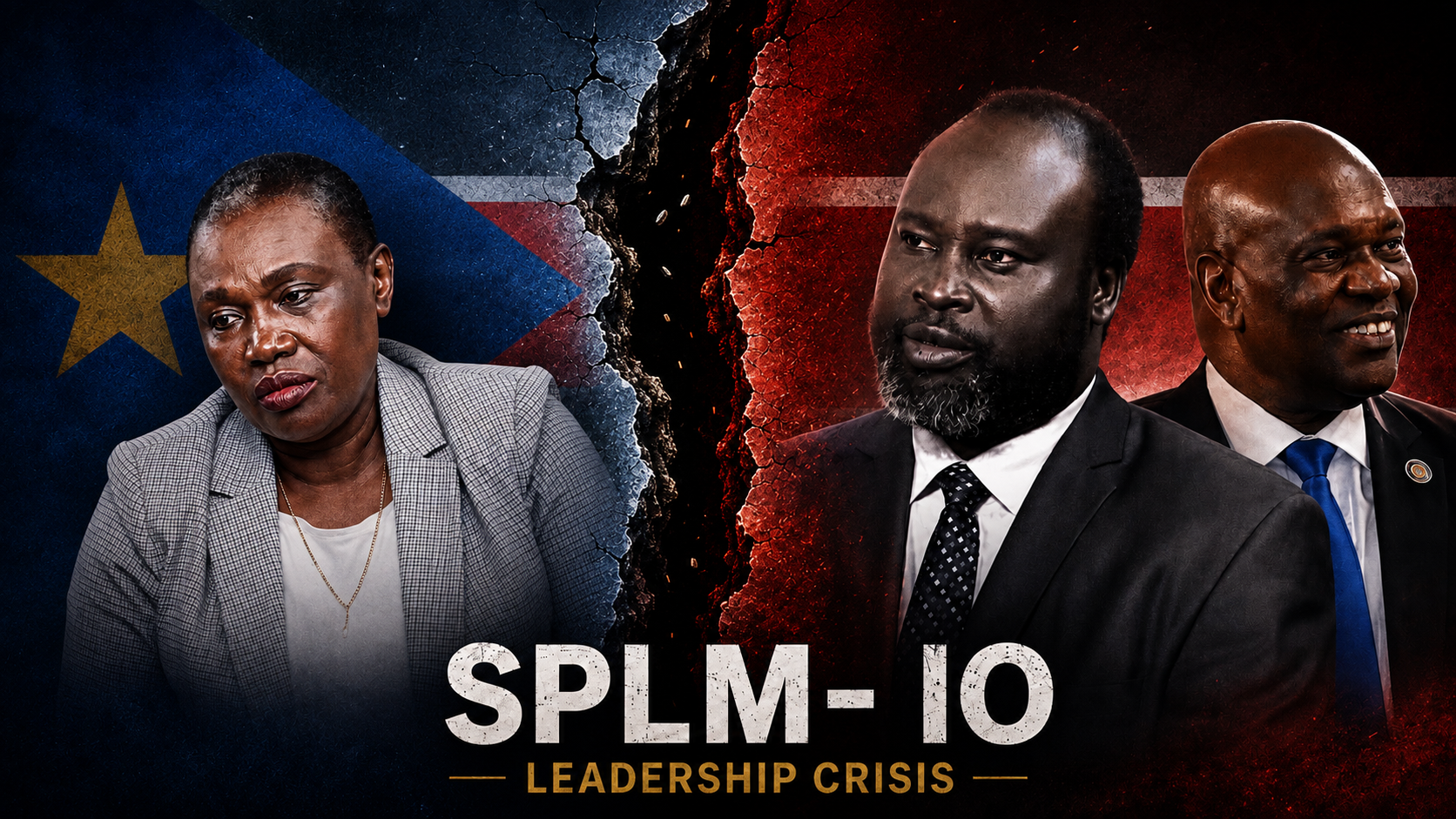
The latest confrontation inside the Sudan People’s Liberation Movement-in-Opposition is easy to describe as a struggle between personalities.
That would miss the larger story.
The rival suspensions now emerging within the SPLM-IO are the latest manifestation of a problem that has followed the movement through much of its existence: who actually exercises authority, how decisions are made, and whether institutional structures are strong enough to restrain competing centres of power.
Acting chairman Oyet Nathaniel Pierino suspended interim Secretary-General Regina Joseph Kapa and seven other senior officials on 31 August, accusing them of actions that undermined the movement’s constitutional structures. Kapa subsequently rejected Oyet’s authority and moved to suspend him, dramatically escalating the dispute and creating competing claims over who can legitimately direct the organisation.
This crisis did not emerge from nowhere.
Long before the present confrontation, senior commanders, politicians and critics had raised questions about leadership, appointments, access to decision-making and the influence surrounding SPLM-IO chairman Riek Machar.
One person repeatedly drawn into that debate is Angelina Teny.
The Angelina Teny question
Any serious examination of Teny’s role requires more precision than the accusation that she simply “controls” Machar or the movement.
She is an experienced political actor in her own right and has occupied significant positions in both the SPLM-IO and government. Her prominence is therefore not explained solely by her marriage to Machar.
But her proximity to the chairman, combined with her own senior political roles, has inevitably generated questions about the concentration of influence around the movement’s leadership.
Those concerns are not new.
When Teny was appointed in 2015 to head the SPLM-IO’s national committee for security and defence, critics within and outside the movement questioned whether having the chairman’s wife occupy such an influential security position created a conflict of interest. SPLM-IO officials defended the appointment and rejected the criticism.
The controversy resurfaced after she became defence minister in the transitional government in 2020. Some critics portrayed the appointment as evidence that political influence had become concentrated around Machar’s family. Others defended Teny’s qualifications and argued that her selection had gone through consultations and should not automatically be characterised as nepotism.
That distinction matters.
There is evidence that Teny has been an influential figure within the SPLM-IO. There is also a long-running body of criticism alleging excessive family or inner-circle influence.
But influence is not the same thing as proof that she personally ordered particular appointments, dismissals or defections.
South Sudan Press has not independently established such claims.
The more important institutional question is why so many consequential decisions within a national political movement can generate persistent perceptions that access to one leader—or those closest to him—matters more than transparent organisational processes.
When generals began walking away
The consequences of the SPLM-IO’s internal tensions became particularly visible through the departure of senior military commanders.
Those departures cannot credibly be attributed to a single individual.
Personal ambition, government pressure, battlefield dynamics, competition for positions, disagreements over implementation of the peace agreement and disputes over Machar’s leadership have all played roles at different times.
But taken together, the defections revealed something deeper: the political and military wings of the movement were becoming increasingly difficult to hold together.
The most consequential rupture came in 2021.
Simon Gatwech Dual was not a marginal commander. He had served as chief of general staff of the SPLA-IO and represented a significant component of the movement’s military establishment.
In August 2021, Gatwech and commanders aligned with him issued the Kit-Gwang Declaration, denounced Machar’s leadership and attempted to replace him with Gatwech as interim leader.
Their declaration accused Machar of abandoning the movement’s military leadership and concentrating political decision-making around himself after entering Juba.
The consequences were serious.
The Kit-Gwang split weakened the SPLM/A-IO militarily and contributed to renewed tensions and fighting in Upper Nile.
Whatever one thinks of Gatwech’s subsequent political decisions, his departure demonstrated a structural weakness the movement never fully resolved.
A political organisation with functioning internal institutions should be capable of surviving disagreements among powerful individuals without repeatedly producing rival commands.
Appointments without political ownership
There is another, quieter problem.
Political movements do not survive through appointments alone.
They survive when appointees understand what they represent, what political programme they are expected to advance and to whom they remain institutionally accountable.
Over the years, some SPLM-IO figures who left or criticised the organisation complained about leadership direction, representation and decision-making. SPLM-IO officials have disputed many of those accusations and have argued that defections were sometimes driven by external influence or individual motivations.
Both sides of that argument deserve recognition.
But repeated departures should still force an organisation to ask itself an uncomfortable question:
Why do senior political and military figures repeatedly reach the point where leaving, defecting or establishing a competing structure appears preferable to resolving disagreements internally?
That question matters more than deciding which personality deserves the greatest share of blame.
Machar cannot be removed from the equation
It would also be analytically inconsistent to examine Angelina Teny’s influence while treating Riek Machar as a passive participant.
Machar is the chairman.
The authority to establish political structures, make or approve senior appointments and define the movement’s direction ultimately rests with the leadership he has headed.
If power became excessively concentrated around an inner circle, that represents a failure of institutional design and leadership—not simply the influence of somebody standing beside the chairman.
That is why the present crisis is so consequential.
Machar’s detention and continuing trial have removed him from normal day-to-day leadership at precisely the moment when the movement most requires an accepted mechanism for succession and delegated authority.
Without the chairman exercising ordinary authority, previously manageable disagreements are becoming constitutional confrontations.
The institution is being tested without its dominant leader.
And the results are troubling.
A movement fighting over who can give orders
The dispute between Oyet and Kapa now exposes the problem in its clearest form.
This is no longer simply disagreement over policy.
It concerns who possesses executive authority.
Who can suspend whom?
Who controls the secretariat?
Who speaks for the Political Bureau?
Who controls political appointments?
Who communicates legitimate instructions to military structures?
And ultimately, who represents the SPLM-IO while Machar remains unable to exercise normal leadership?
When senior officials can issue competing suspension orders against each other, constitutional ambiguity has moved from an internal administrative problem to an organisational crisis.
What the crisis exposes
Authority: Competing claims over who can appoint, suspend and direct senior officials.
Institutional weakness: Internal rules appear unable to prevent political disagreements from becoming rival command structures.
Military cohesion: Previous defections show how leadership disputes can spill into the armed wing.
Political direction: The movement risks spending more energy on internal survival than on the programme it claims to represent.
The case for the defence
There is another side that should not be ignored.
Supporters of Machar and Teny have long rejected claims that the SPLM-IO operates as a family enterprise.
They point to Teny’s political experience, participation in negotiations and security arrangements, and her own history within South Sudanese politics.
Defenders also argue that some commanders who left the movement had their own political ambitions and that Juba has historically had incentives to weaken opposition organisations through political accommodation, appointments and defections.
Those arguments deserve consideration.
It would therefore be misleading to construct a simple history in which Angelina Teny pushed generals away one after another and single-handedly produced today’s fragmentation.
The historical record is considerably more complicated.
But rejecting an overly simplistic accusation does not eliminate the underlying governance question.
A credible political movement should not depend on the public believing that important decisions are made correctly. Its institutions should make the process demonstrably clear.
The contradiction at the heart of the SPLM-IO
The SPLM-IO emerged during South Sudan’s catastrophic political crisis after December 2013 and subsequently positioned itself as a movement demanding political reform, institutional change, security-sector transformation and implementation of peace agreements.
That creates a particularly demanding standard.
A movement seeking to reform the state must demonstrate that it can govern itself.
It cannot convincingly demand institutional accountability nationally while allowing ambiguity over authority internally.
It cannot criticise personalised government while depending excessively on one political personality.
And it cannot promise democratic transformation while appointments, dismissals and succession continually become sources of internal suspicion.
This is where the present crisis becomes larger than Angelina Teny, Regina Kapa, Oyet Nathaniel or even Riek Machar.
It becomes a question about the political model of the movement itself.
From liberation politics to institutional politics
South Sudan’s political organisations have repeatedly struggled to make this transition.
Armed and liberation movements naturally develop around command structures, personalities, loyalty networks and wartime decision-making.
Political parties require something different.
They require predictable constitutions, internal elections, transparent appointments, defined succession, dispute-resolution mechanisms, accountable finances, clear separation between political and military authority, and institutions capable of surviving their founders.
Without that transition, political organisations can remain trapped in a recurring cycle:
leader → inner circle → dissatisfied faction → defection → reconciliation → appointment → renewed dispute.
The names change.
The institutional weakness remains.
Is the SPLM-IO losing its original direction?
That is ultimately the question raised by today’s crisis.
The SPLM-IO can continue treating every internal rupture as the misconduct of particular individuals.
Or it can confront the possibility that repeated ruptures indicate something structurally wrong.
The departure of senior commanders should have prompted institutional reform.
The Kit-Gwang rupture should have prompted institutional reform.
Years of complaints about appointments and decision-making should have prompted institutional reform.
Machar’s detention should have accelerated the creation of an unquestionably legitimate interim command structure.
Instead, the movement now faces rival suspensions and competing interpretations of authority.
That is not merely a leadership dispute.
It is evidence of an institution struggling to function when its traditional centre of gravity is absent.
The movement’s greatest threat may be internal
Governments can weaken opposition movements.
Military pressure can weaken them.
Arrests can weaken them.
Political inducements and defections can weaken them.
But opposition movements can also weaken themselves.
The SPLM-IO’s future therefore depends on more than determining whether Oyet or Kapa wins the current confrontation—or determining how much influence Angelina Teny exercises around Machar.
Its survival as a credible national political organisation depends on whether institutions can finally become stronger than personalities.
If appointments continue generating resentment, if political cadres lack a shared direction, if military commanders repeatedly establish alternative structures, and if leadership disputes can only be settled through suspensions and counter-suspensions, the movement risks gradually losing the political purpose that once held its different constituencies together.
That would make the current crisis more than another SPLM-IO internal dispute.
It would mark another stage in the transformation of a movement that once sought to change South Sudan’s political system into an organisation increasingly consumed by the struggle to govern itself.
This analysis draws on the SPLM/SPLA-IO suspension order dated 31 August 2026 reviewed by South Sudan Press, reporting on the current leadership dispute, and the historical record of SPLM-IO leadership disputes and military defections. Claims about individual responsibility remain attributed where they have not been independently established.