
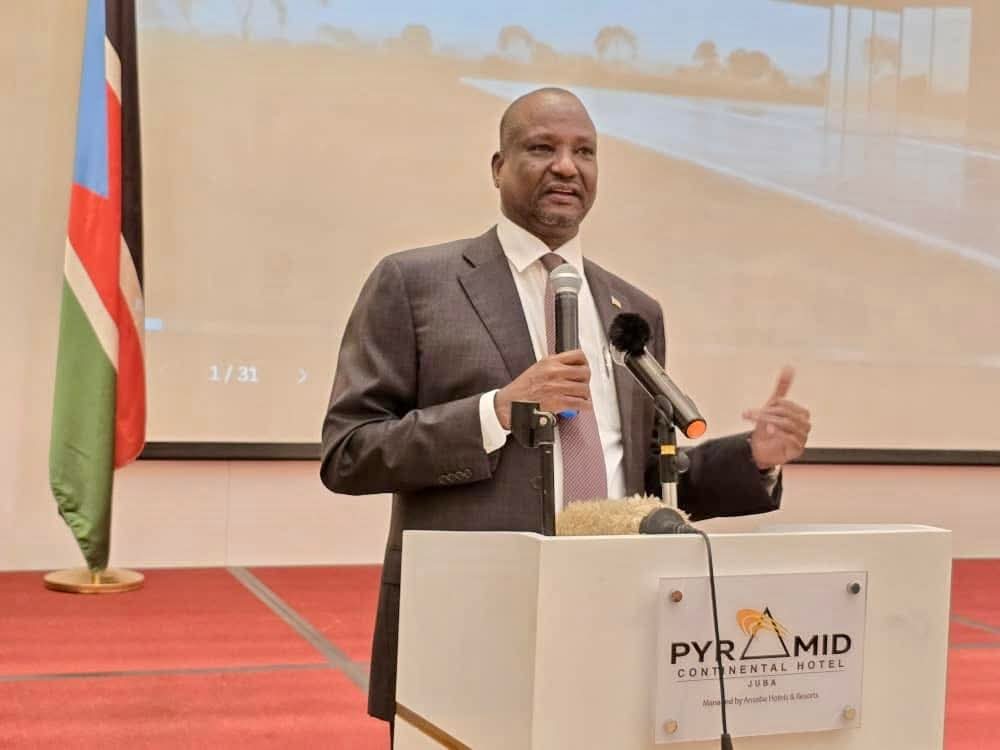
Vice President Gen. Taban Deng Gai’s unusually direct assessment of South Sudan’s infrastructure record deserves attention beyond the logistics conference where it was delivered.
Speaking at the conclusion of the 7th Edition of the Global Logistics Convention 2026 in Juba, Deng acknowledged that the country lacks adequate roads and energy infrastructure and said public resources had not been consistently directed toward productive development.
“From 2005 up to today, we did not build roads, and we did not think of making a refinery, even a single one.”
That observation goes to the heart of South Sudan’s economic challenge. The country is not merely suffering from an infrastructure shortage. It is paying the accumulated cost of years in which oil income, public revenue and political attention did not generate the transport, electricity and industrial systems required for a functioning modern economy.
Roads are economic infrastructure, not simply construction projects
South Sudan’s road deficit affects almost every part of the economy.
For a landlocked country, reliable road corridors are essential for bringing food, fuel, machinery and consumer goods into the country and moving agricultural products and livestock toward domestic and regional markets.
The Juba–Nimule corridor is particularly important because it connects the capital to Uganda and, through the wider East African transport network, to Kenya and the port of Mombasa. The Juba–Nadapal corridor has similar strategic importance because it provides another connection toward Kenya.
Poor roads do more than inconvenience travellers. They increase transport time, vehicle maintenance costs, fuel consumption and commercial risk. Those costs eventually appear in the prices paid by households.
The infrastructure cost chain
Poor roads → higher transport costs → more expensive food, fuel and construction materials → weaker household purchasing power and business competitiveness.
When transport becomes expensive, almost everything becomes expensive. Food brought into Juba costs more. Construction materials cost more. Agricultural producers receive less because traders must account for the cost and risk of moving goods. Humanitarian organisations also spend more reaching remote communities.
Infrastructure therefore functions almost like an invisible tax on the entire economy.
The deeper admission: South Sudan failed to convert oil into infrastructure
Deng linked the present situation to decisions stretching back to 2005, when the Comprehensive Peace Agreement created the autonomous Government of Southern Sudan.
That period matters because significant oil revenues were available before and after independence. The vice president argued that resources were not consistently directed toward roads, energy and other productive infrastructure.
His reference to the later oil-for-roads programme is important. Deng cited improvements toward Bor and Terekeka as evidence that roads can quickly alter local economic conditions.
But the broader lesson should not simply be that South Sudan needs another oil-backed construction programme. The more important question is whether infrastructure financing can be made transparent, economically justified and publicly accountable.
An oil-producing country can still remain infrastructure-poor if contracts are opaque, projects are poorly prioritised, costs are inflated or maintenance is neglected.
PPPs could help — but toll roads are not free infrastructure
Deng suggested that South Sudan should increasingly use public-private partnerships, allowing investors to construct and operate roads and potentially recover their investment through road tolls.
That approach deserves serious consideration. South Sudan cannot realistically depend on the public budget alone to close its enormous infrastructure deficit. Private capital, development finance institutions and regional investors could play a substantial role.
But PPPs are not free money.
If an investor finances a highway, that investor must eventually recover the capital and earn a return. The cost may appear through tolls, government guarantees, long-term concessions or some combination of these mechanisms.
A credible PPP framework therefore needs to explain:
- how projects are awarded;
- how tolls are calculated;
- how long concessions last;
- what happens to existing transport taxes;
- who carries construction and revenue risk;
- how contracts are audited; and
- when infrastructure ultimately returns to public control.
Without those safeguards, PPPs can simply replace opaque public borrowing with opaque private concessions.
Electricity may be an even bigger constraint
The vice president also acknowledged one of South Sudan’s most serious structural problems: electricity remains extremely limited outside Juba.
His observation that some electricity exists in the capital while cities such as Bor and Rumbek remain largely without reliable power illustrates the scale of the national infrastructure gap.
Electricity is not merely a household service. Reliable power determines whether businesses can manufacture goods, refrigerate food, operate machinery, run digital systems and remain competitive.
A company forced to generate its own electricity using imported diesel faces a significant disadvantage before it even begins producing anything. That helps explain why South Sudan imports so much of what it consumes.
Importing electricity can help, but South Sudan still needs a national energy strategy
Deng said the government plans to import additional electricity from Uganda and Ethiopia.
Regional electricity integration makes economic sense. South Sudan does not need to generate every unit of electricity domestically if neighbouring countries can supply power reliably and competitively.
But imports cannot substitute for a functioning domestic transmission and distribution network. Electricity purchased at the border still has to reach Juba, Bor, Malakal, Wau, Rumbek, Yambio and other population centres.
Three questions for national electrification
Where will electricity come from?
How will it be transmitted?
Who will be able to afford it?
Until all three are addressed, regional power agreements alone will not produce nationwide electrification.
Fuel prices reveal the cost of being landlocked
Deng also connected infrastructure weakness with the high cost of diesel.
This matters because South Sudan currently depends heavily on imported petroleum products even though it produces crude oil.
That paradox has existed for years: crude leaves the country while refined fuels return through long regional supply chains. Every border crossing, tanker journey and logistical bottleneck adds cost.
Diesel prices then affect transportation, agriculture, construction and electricity generation. A farmer operating machinery pays the fuel cost. A truck carrying food pays it. A business running a generator pays it. Ultimately the consumer pays it.
A refinery is attractive — but economics matter
The vice president argued that South Sudan should have developed domestic refining capacity and described the failure to establish even one refinery as evidence of poor policy.
The argument is understandable. A domestic refinery could potentially reduce dependence on imported fuel, create industrial employment and retain more value from South Sudanese crude.
But refinery economics require careful analysis. A refinery must operate at sufficient scale, maintain reliable crude supply, secure financing, meet environmental and technical standards and produce fuel at a price competitive with imports.
South Sudan therefore needs more than the political declaration that a refinery should exist. It needs a transparent feasibility assessment answering whether domestic refining is economically sustainable — and at what scale.
Banks and the missing South Sudanese entrepreneur
Perhaps one of Deng’s most important observations concerned commercial lending.
He criticised banks for failing to finance young South Sudanese entrepreneurs and suggested that some foreign-owned institutions are more willing to finance businesses associated with their home countries.
Whether that pattern can be demonstrated systematically requires evidence from lending data. But the underlying problem is real: an economy cannot develop a substantial domestic private sector when local businesses cannot obtain affordable long-term credit.
Most entrepreneurs cannot finance warehouses, hotels, factories, farms, transport fleets or equipment entirely from personal savings. If commercial credit remains inaccessible, the economy naturally becomes dominated by businesses with external capital or political connections.
The collateral problem exposes a larger land problem
Deng also identified a connection between lending and land policy.
Banks commonly demand property as collateral. But where land tenure is uncertain, ownership documentation is contested or leases are too short relative to investment horizons, land becomes weak collateral.
The land-credit-investment cycle
Uncertain land rights → weak collateral → limited bank lending → low investment → fewer businesses and jobs.
The vice president linked this challenge to his support for moving the national capital to Ramciel. Whether relocating the capital would solve South Sudan’s broader land-governance problems is debatable.
The more immediate issue is whether property rights, leases, land registration and commercial dispute resolution can become sufficiently predictable for both citizens and investors.
South Sudan’s problem is becoming one of lost time
Perhaps the most important phrase in Deng’s remarks was his repeated reference to “wasting time.”
South Sudan has spent much of the period since 2005 dealing with political competition, armed conflict, institutional instability and recurrent economic crises.
Those crises have enormous human consequences. But they also have an opportunity cost.
- Every year without reliable roads is another year farmers struggle to access markets.
- Every year without electricity is another year businesses rely on generators.
- Every year without affordable credit is another year young entrepreneurs struggle to scale.
- Every year without efficient fuel supply means more foreign exchange leaves the economy.
Infrastructure deficits accumulate just as financial debts do.
The policy test begins after the speech
The vice president’s acknowledgement is significant because senior officials rarely describe the country’s infrastructure record so explicitly.
But acknowledgement alone does not build roads. The real test is whether the government converts the diagnosis into measurable policy.
What South Sudan Press will watch
1. Whether the government publishes a prioritised national infrastructure programme rather than announcing isolated projects.
2. Whether proposed PPP road concessions and toll arrangements are made public.
3. Whether electricity-import agreements with Uganda and Ethiopia include realistic transmission plans.
4. Whether the government commissions a transparent refinery feasibility study.
5. Whether commercial-bank lending data becomes available so claims about inadequate lending to South Sudanese businesses can be tested objectively.
6. Whether land reform improves collateral security and investor confidence without dispossessing communities.
Infrastructure may be the country’s most consequential peace dividend
South Sudan’s political debates often focus on positions, appointments, agreements and elections.
But for ordinary citizens, the credibility of the state may eventually depend just as heavily on whether a road remains passable during the rainy season, whether a clinic has electricity, whether farmers can reach markets and whether a young entrepreneur can obtain financing.
Roads, electricity, affordable fuel and productive finance are not secondary development issues. They determine whether peace produces something people can actually experience.
Vice President Taban Deng Gai has now publicly acknowledged the scale of the failure.
The next question is more difficult:
Can the government demonstrate that the era of recognising the infrastructure problem is finally giving way to the era of building?