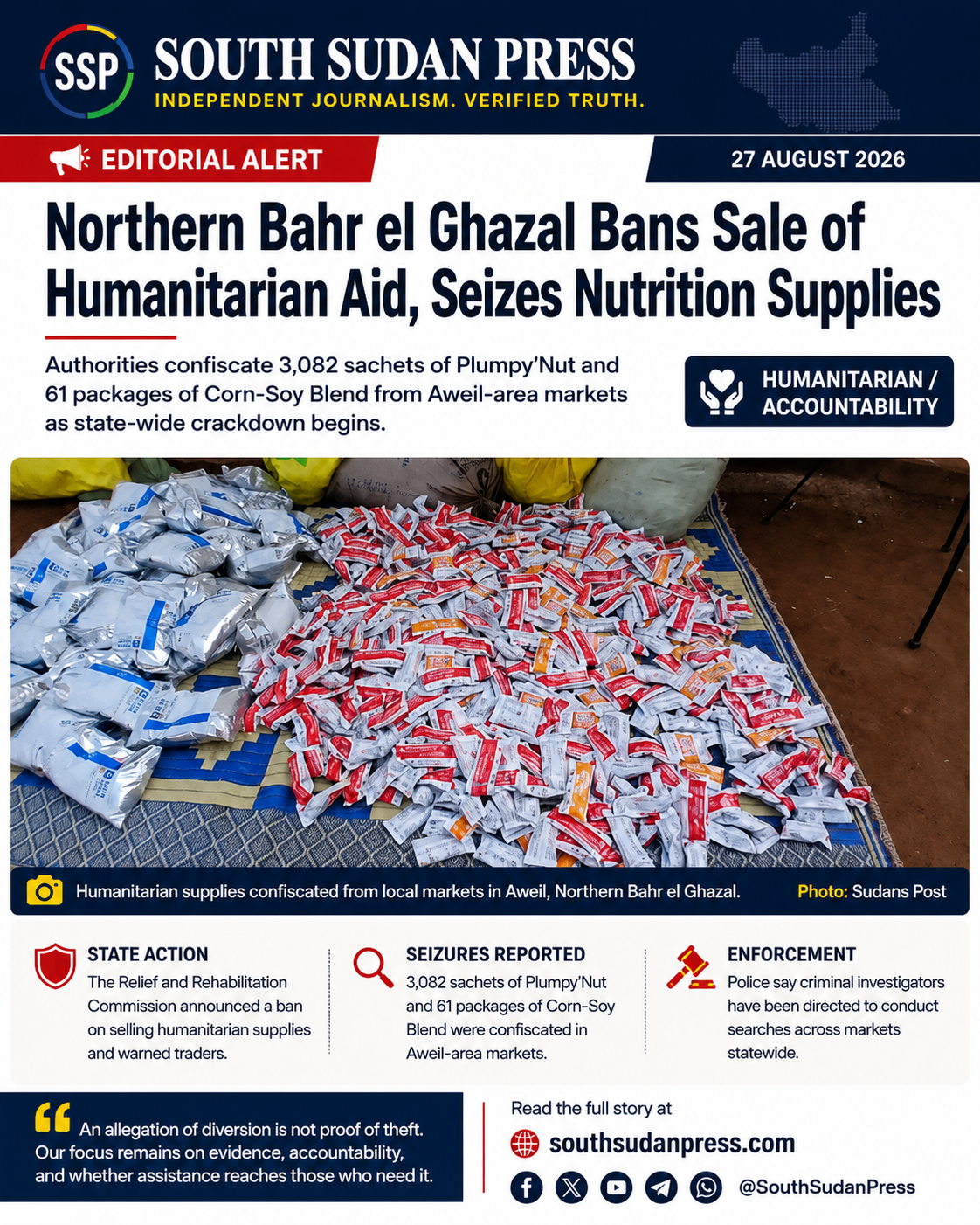
Authorities in Northern Bahr el Ghazal State have announced a statewide ban on the sale of humanitarian supplies and say thousands of specialised nutrition products have already been confiscated from markets in the Aweil area.
Sudans Post reported on 27 August that the state Relief and Rehabilitation Commission said it had confiscated 3,082 sachets of Plumpy’Nut and 61 packages of Corn-Soy Blend in Naivasha and Maper Akot Aru. Officials said searches were being expanded to counties across the state.
What the authorities announced
Gabriel Bol Dut, acting chairperson of the Northern Bahr el Ghazal Relief and Rehabilitation Commission, said humanitarian assistance distributed to vulnerable communities should not be sold in markets and should instead reach intended beneficiaries based on need.
Maj. Gen. Gabriel Guet Padiet, the state police commissioner, was reported as saying that the Criminal Investigation Department had been directed to search markets for relief supplies.
Separate local reporting published a day earlier said the RRC had already warned residents against selling humanitarian commodities, including Plumpy’Nut, a specialised nutrition product used in the treatment of child malnutrition.
Arrests have been reported
The Nile Witness reported on 27 August that three youths had been arrested after allegedly being found selling humanitarian food aid in local markets. That report said the arrests followed the RRC order banning sales of humanitarian supplies.
An arrest is not a finding of guilt. South Sudan Press has not independently confirmed whether charges have been filed, what specific offences are alleged, or whether any case has reached a court.
What is established — and what is not
Established from attributed reporting: the RRC announced a ban; officials reported seizures of Plumpy’Nut and Corn-Soy Blend; police said market searches would expand; and local reporting says three people were arrested.
Not yet established: how the products entered the markets; whether they were diverted before reaching beneficiaries; whether beneficiaries themselves resold them; who bears individual responsibility; and what legal proceedings, if any, have followed.
Why the distinction matters
Humanitarian diversion can deprive vulnerable people of essential assistance and undermine confidence in aid programmes. But the appearance of relief goods in a market does not, by itself, establish how they got there.
Supplies may enter markets through different routes, including organised diversion somewhere in the supply chain or resale by individual recipients facing economic pressure. The reporting available so far does not establish which explanation applies to the confiscated goods.
That distinction is important both for accountability and for the protection of beneficiaries. Enforcement should be based on evidence about individual conduct rather than assumptions about traders, recipients or communities.
Questions for aid agencies
The reported seizures also create a supply-chain question for humanitarian organisations operating in Northern Bahr el Ghazal. Sudans Post identified implementing partners including Action Against Hunger, the International Rescue Committee and HealthNet.
South Sudan Press would seek to establish whether batch markings or distribution records can identify the origin of the confiscated products, whether any internal diversion investigations are under way, and whether agencies have changed distribution procedures in response.
What happens to confiscated supplies?
A key accountability question is what happens after humanitarian goods are seized. Authorities should be able to document what was confiscated, where it is stored, who has custody of it and whether usable products are ultimately returned to humanitarian programmes or intended beneficiaries.
Transparent seizure records would help protect aid from further diversion while also reducing the risk that enforcement itself becomes arbitrary or unaccountable.
Legal basis remains unclear
Officials have referred publicly to rules governing humanitarian assistance, but the reporting reviewed by South Sudan Press does not identify the specific domestic legal provisions authorising market searches, confiscation, arrest or prosecution in these cases.
A written copy of the state order, together with any cited statutory or regulatory basis, would help clarify the scope of the ban and the rights and obligations of traders, aid recipients and humanitarian organisations.
What South Sudan Press is seeking to verify
- The written RRC order and the specific legal basis for enforcement.
- Whether the seized products can be traced through batch or distribution records.
- Whether the three reported arrests have resulted in formal charges or court appearances.
- Where confiscated supplies are being stored and what authorities intend to do with them.
- Whether aid agencies have identified organised supply-chain diversion.
- Whether some of the goods were originally distributed to beneficiaries who later resold them.
- What complaint or appeal mechanism exists for people whose goods are confiscated.
Why this matters
The crackdown marks a shift from public warnings about alleged aid diversion to active enforcement involving searches, seizures and reported arrests.
Protecting humanitarian assistance is a legitimate public-interest objective. But credible enforcement depends on evidence, transparent procedures and individual accountability. An allegation of diversion is not proof of theft, and any anti-diversion effort should also demonstrate that recovered assistance ultimately reaches people who need it.