DATA REPORT · CONNECTIVITY · MONDAY, 9 NOVEMBER 2026
Internet Use Remains Below 20%, but Subscriber and Coverage Figures Need Care
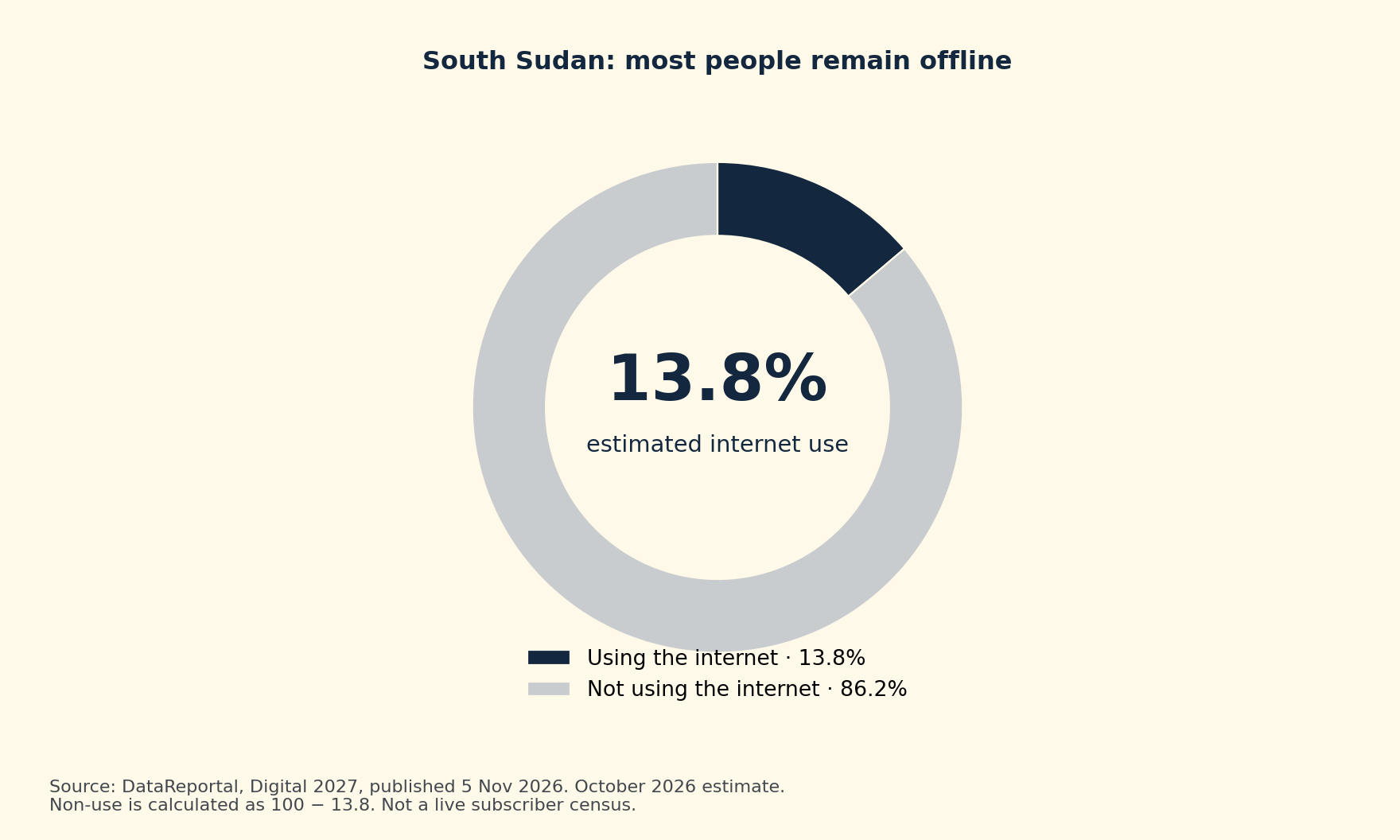
The latest DataReportal release estimates 13.8% internet use in October 2026; reliable usage breakdowns by age and jurisdiction remain unavailable in the sources reviewed.
South Sudan Press · Analysis & data desk
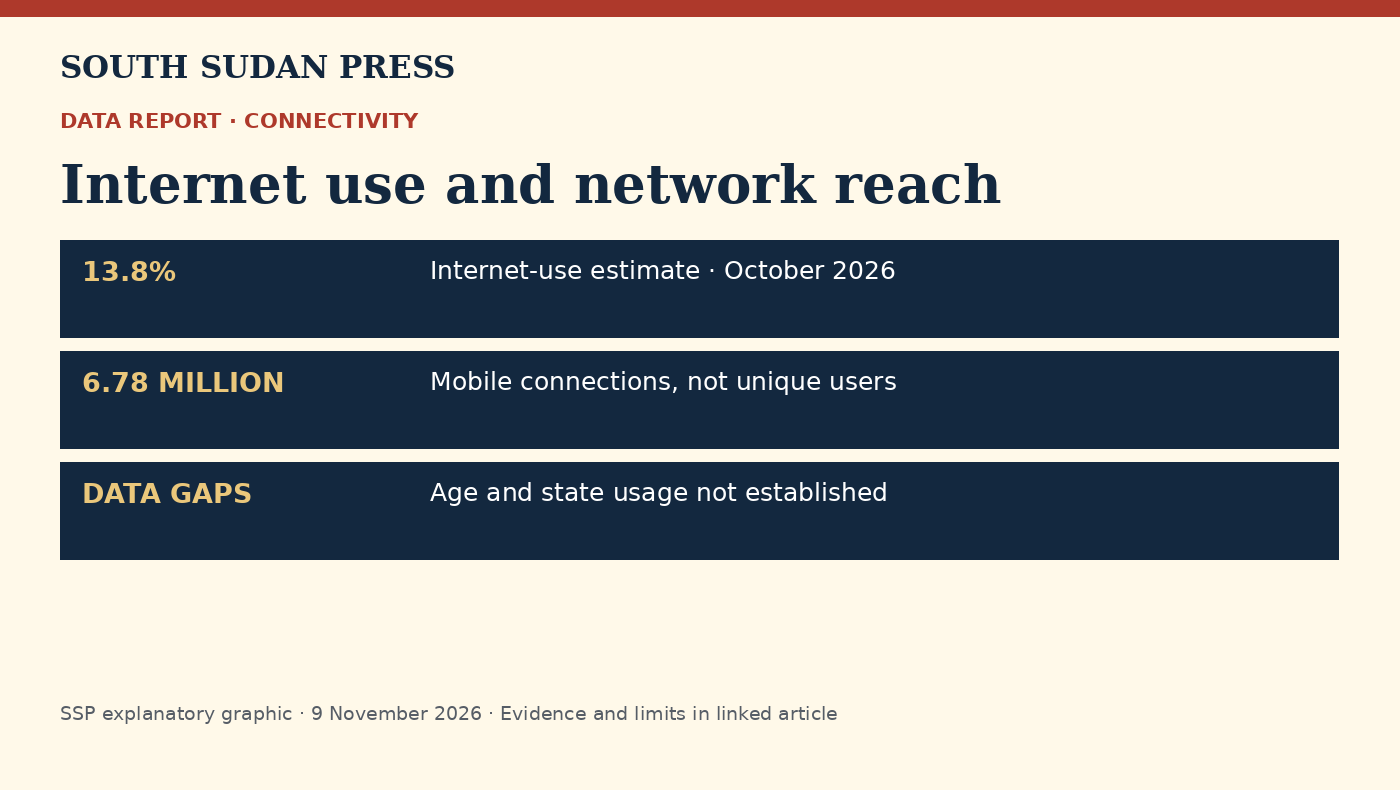
South Sudan’s internet audience remains a minority of its population, but the most useful reporting must distinguish people using the internet, active mobile connections and the potential reach of a network.
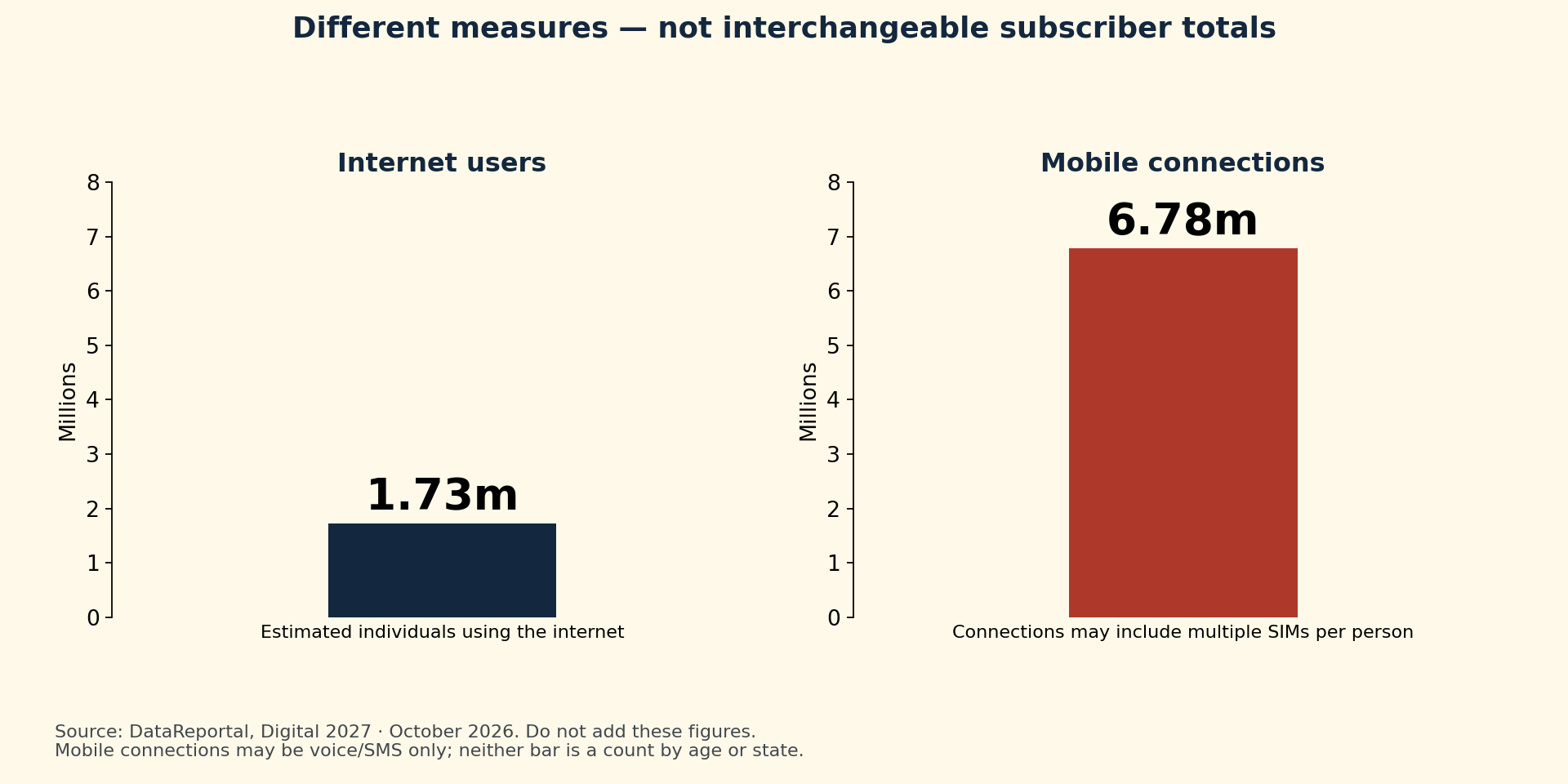
DataReportal’s Digital 2027 country report, published on 5 November 2026, gives October 2026 estimates of 1.73 million internet users and 13.8 per cent penetration. It also reports 6.78 million mobile connections. The edition name refers to the coming year; these are published late-2026 estimates, not observations collected in 2027.
The three headline figures should not be added together or treated as interchangeable. Connections can include multiple SIMs held by one person and services used only for voice or text. The penetration estimate uses the source’s population base; it should not be recomputed using a different population estimate without reconciling the methodology.
Providers and the limits of coverage claims
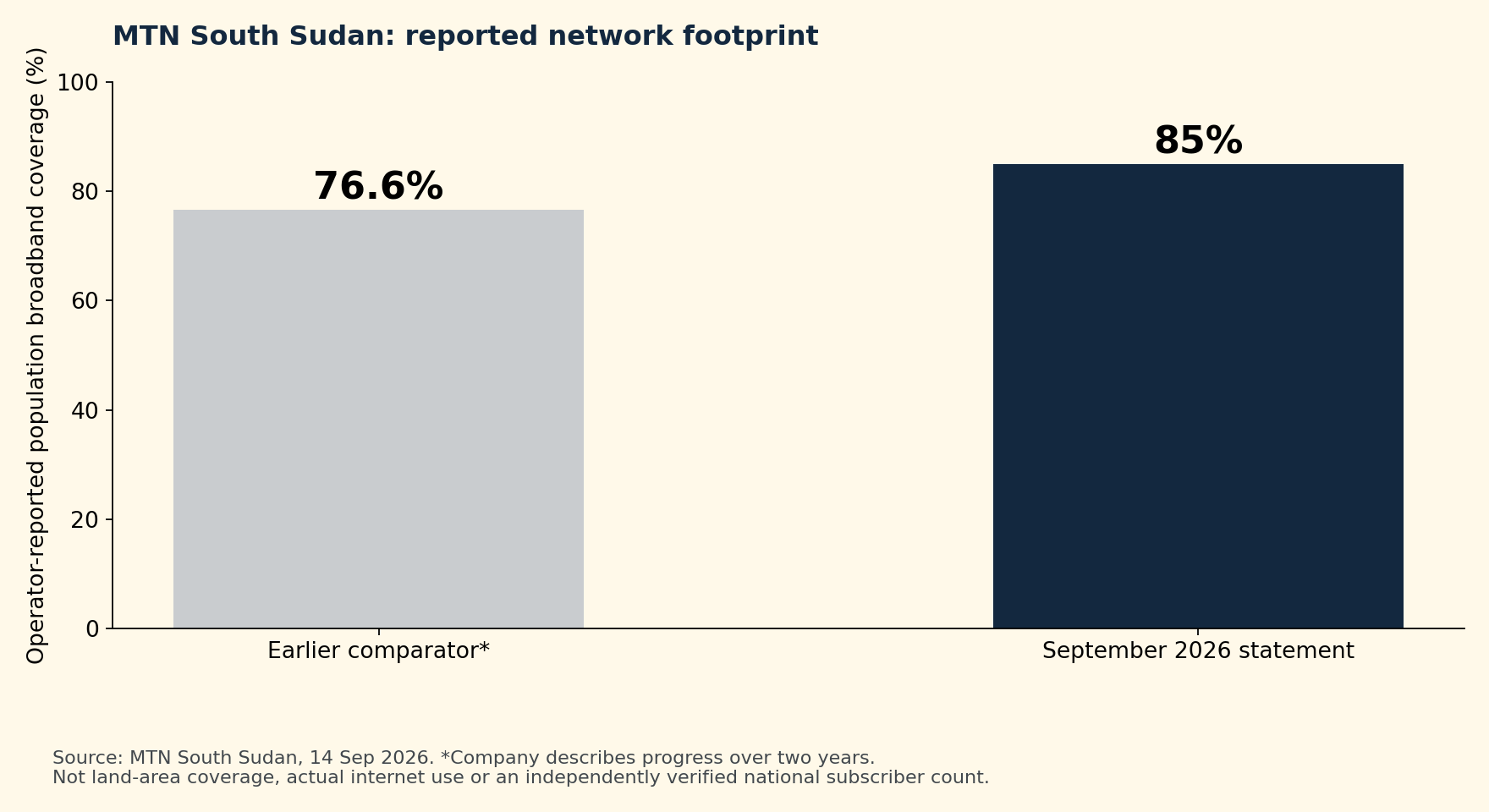
MTN South Sudan’s 14 September statement said a partnership with CREI had modernised more than 500 sites and raised population broadband coverage from 76.6 to 85 per cent. That is an operator-reported footprint, not the percentage of people buying data or the share of the country’s land area covered.
Digitel advertises mobile and home 4G services. Zain identifies South Sudan in its group reporting, but the page reviewed does not supply a complete comparable local internet-subscriber series. RCS advertises fibre services, while IPTEC markets fibre, wireless and Starlink-related services. IPTEC describes itself as an authorised Starlink provider; this report has not independently inspected the underlying approval document.
The accompanying provider table is therefore a service-and-evidence guide, not a market-share ranking or a complete licensing register. Availability and installation feasibility should be checked for the customer’s actual location.
What the age and geographic charts can honestly show
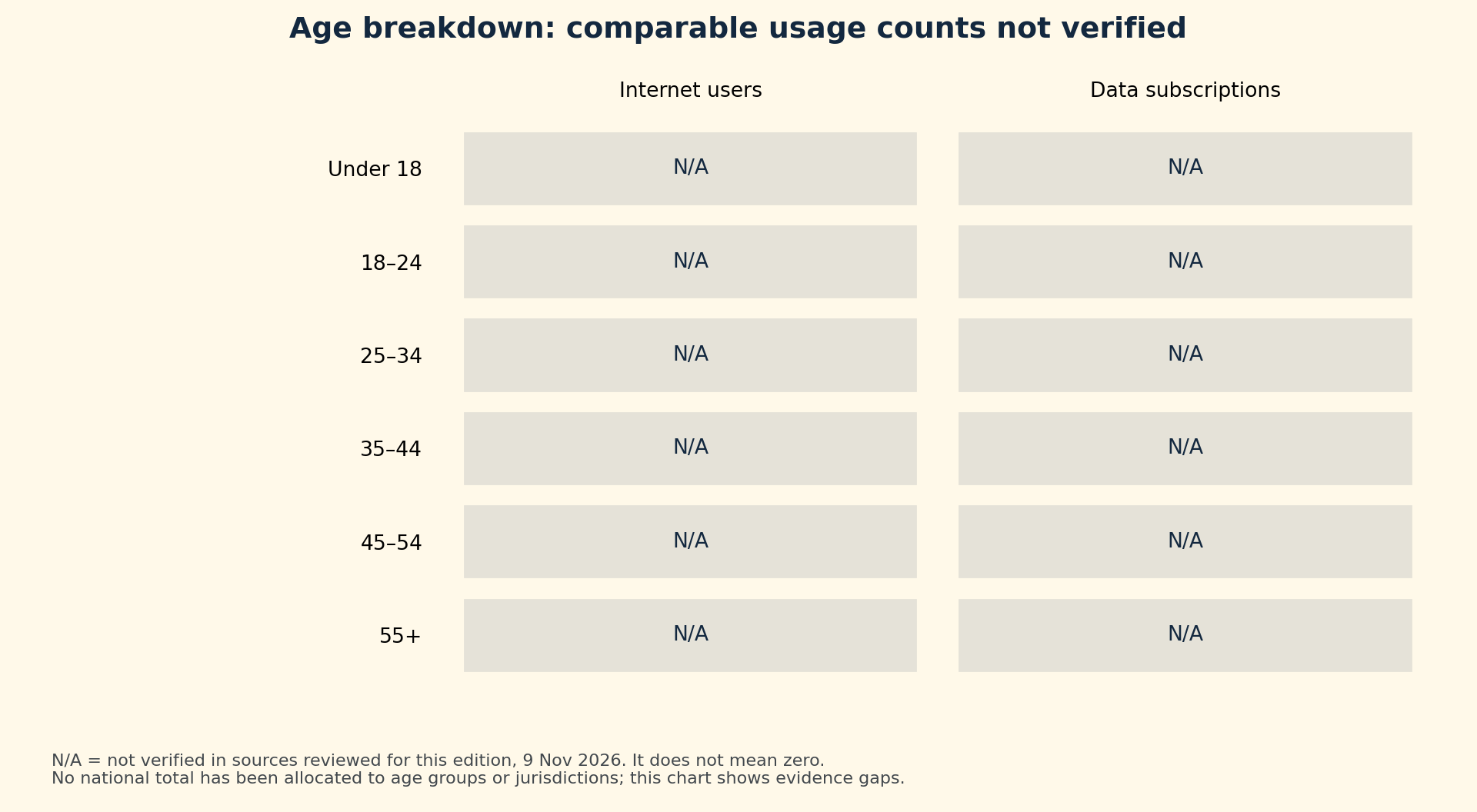
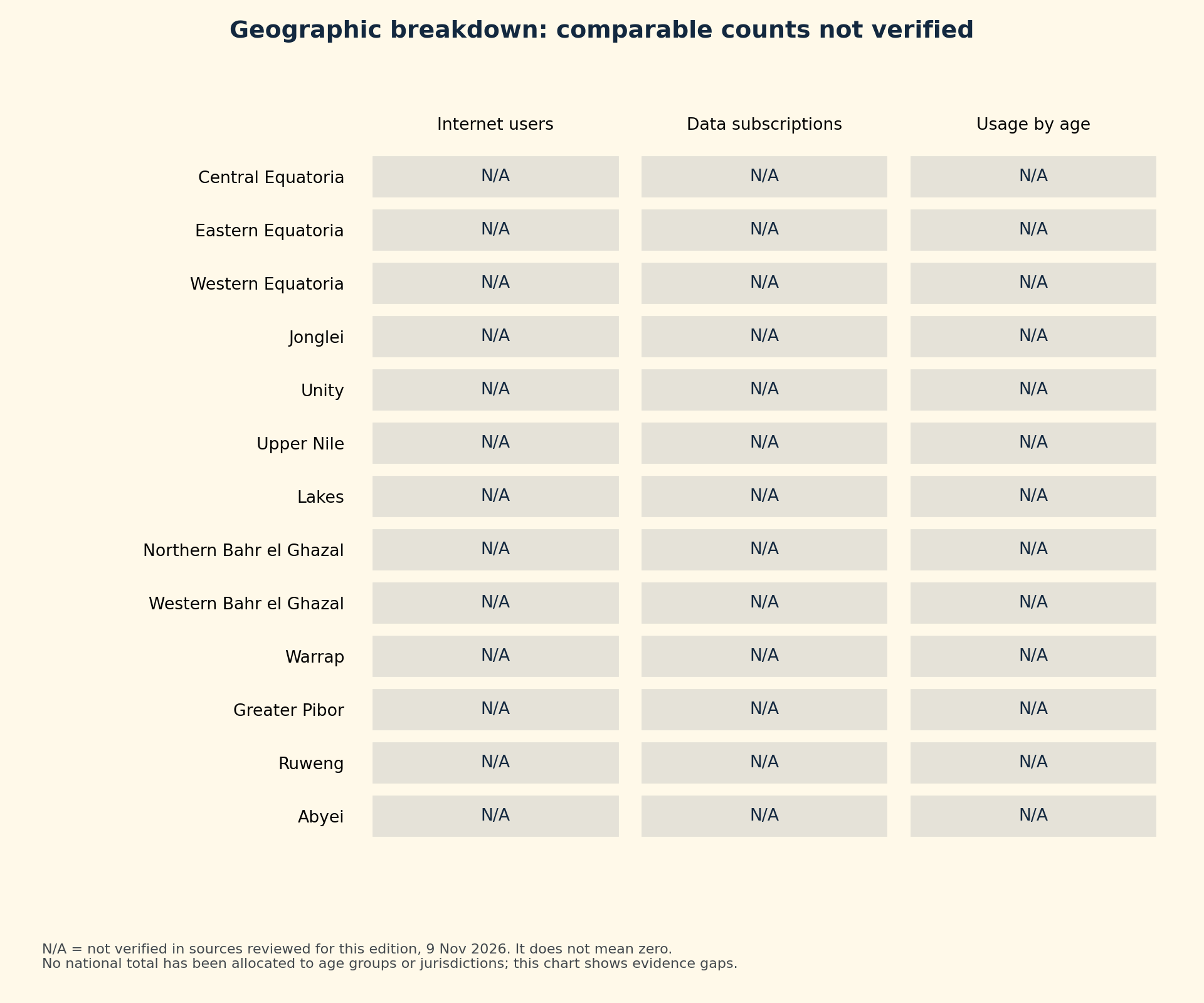
The sources reviewed do not provide a defensible table of internet users or subscriptions by age group across all ten states and three administrative areas. The charts mark those cells as not available; no percentages have been imputed.
Population age shares are not internet-use shares. Applying the national penetration rate equally to every age group or county would create a model, not reveal measured behaviour. Social-platform advertising audiences are also an unsuitable substitute for all internet users or paid subscriptions.
For the same reason, this report does not allocate national users among Juba, rural counties or displacement sites according to population size. Shared devices, public access, workplace connections and differing affordability make that assumption particularly weak.
What would close the evidence gap
The regulator could publish a dated, anonymised series separating active SIMs, active data subscriptions, fixed connections and unique-user estimates. Definitions should state the activity window, whether business accounts are included and how duplicate subscriptions are handled.
Geographic tables need a consistent basis: residence, billing address or the location of recent network use. Those are different measures. Age reporting also needs a lawful and reliable source, with safeguards where an adult registers a device used by a child or a shared household account.
No public-interest report needs individual subscriber identities or precise personal movements. Aggregated statistics can support planning while protecting privacy, particularly in small or conflict-affected communities.
Coverage alone will not create adoption
A signal is only one requirement. Households also need an affordable device, power, data, relevant content and confidence using services. This report does not quantify the separate contribution of each barrier; doing so would require a representative user and non-user survey.
Providers should disclose outage information, practical service areas and the full cost of obtaining and maintaining a connection. Public programmes should measure whether people can complete useful tasks rather than count infrastructure alone.
For election information and online education, the implication is immediate: retain radio, printable and low-data options while digital access expands. An internet-first service can be valuable, but a national information strategy must also serve people who remain offline.
Providers: services and evidence
| Provider | Service category | Reviewed evidence | Limit |
|---|---|---|---|
| MTN South Sudan | Mobile broadband | 85% population broadband coverage reported 14 Sep 2026 | Company claim; no state-by-state user table reviewed |
| Zain South Sudan | Mobile network | South Sudan identified in group reporting | No comparable local internet-user series on page reviewed |
| Digitel | Mobile / home 4G | Services advertised on company website | No audited geographic or age subscriber counts reviewed |
| RCS-Communication | Fibre / business connectivity | Fibre services advertised | Check site feasibility; not a national footprint measurement |
| IPTEC | Fibre / wireless / satellite offerings | Markets Starlink-related service with claimed authorisation | Underlying approval not independently inspected here |
Evidence limit: No verified internet-use or subscription counts by these age groups and jurisdictions were established in the reviewed sources. N/A means not available, never zero. The national estimate is not allocated across these groups.
Charts: dated national indicators
Download the chart data
National indicators and definitions (CSV) · Age and geographic data gaps (CSV)
Sources and reporting note
- https://datareportal.com/reports/digital-2027-south-sudan
- https://www.mtn.com.ss/mtn-south-sudan-accelerates-network-expansion-bringing-connectivity-to-more-communities/
- https://www.digitelss.com/
- https://zain.com/SR2025/16-customer-base/
- https://iptecltd.com/satellite-connectivity-starlink
- https://rcs-southsudan.com/service-map/fibre-services/
- https://www.nca.gov.ss/our-services/licensing
Prepared from linked published reporting and primary sources. Analysis and proposed actions are identified as such. SSP does not claim to have conducted interviews or sent requests for this edition. Estimates and disputed claims retain their stated limitations.
Monday’s special reports
Graduates Need a Route Into Work, Not a Presumption of Violence
South Sudan’s News Gap Is About Reach, Language and Reporting Freedom
Internet Use Remains Below 20%, but Subscriber and Coverage Figures Need Care
Understand the process. Check your location.
SouthSudanElections.org — learn about election participation →
SouthSudanVoting.info — explore area guidance and voting information →
These are independent civic resources. Confirm registration dates, eligibility rules and centre locations against a current NEC notice. A registration centre is not automatically a polling station. A confirmed nationwide centre directory was not verified for this edition.
ADVERTISEMENT · CYBERPASS ACADEMY

Online learning planned from early 2027. Visit www.CyberPass.co for announcements. Course dates, fees and enrolment details to be announced.
ADVERTISEMENT · WEB SERVICES & DOMAIN NAMES

Build a home online for your business, school, NGO or charity. Ask about hosting, website development and selected short four-letter domain names, including names beginning or ending with SS.
Short. Memorable. Easy to say on radio. Each name is subject to availability and individual pricing.