ANALYSIS · PUBLIC INFORMATION · MONDAY, 9 NOVEMBER 2026
South Sudan’s News Gap Is About Reach, Language and Reporting Freedom
A national media strategy must connect local reporting with radio, accessible digital formats and safe working conditions.
South Sudan Press · Analysis & data desk
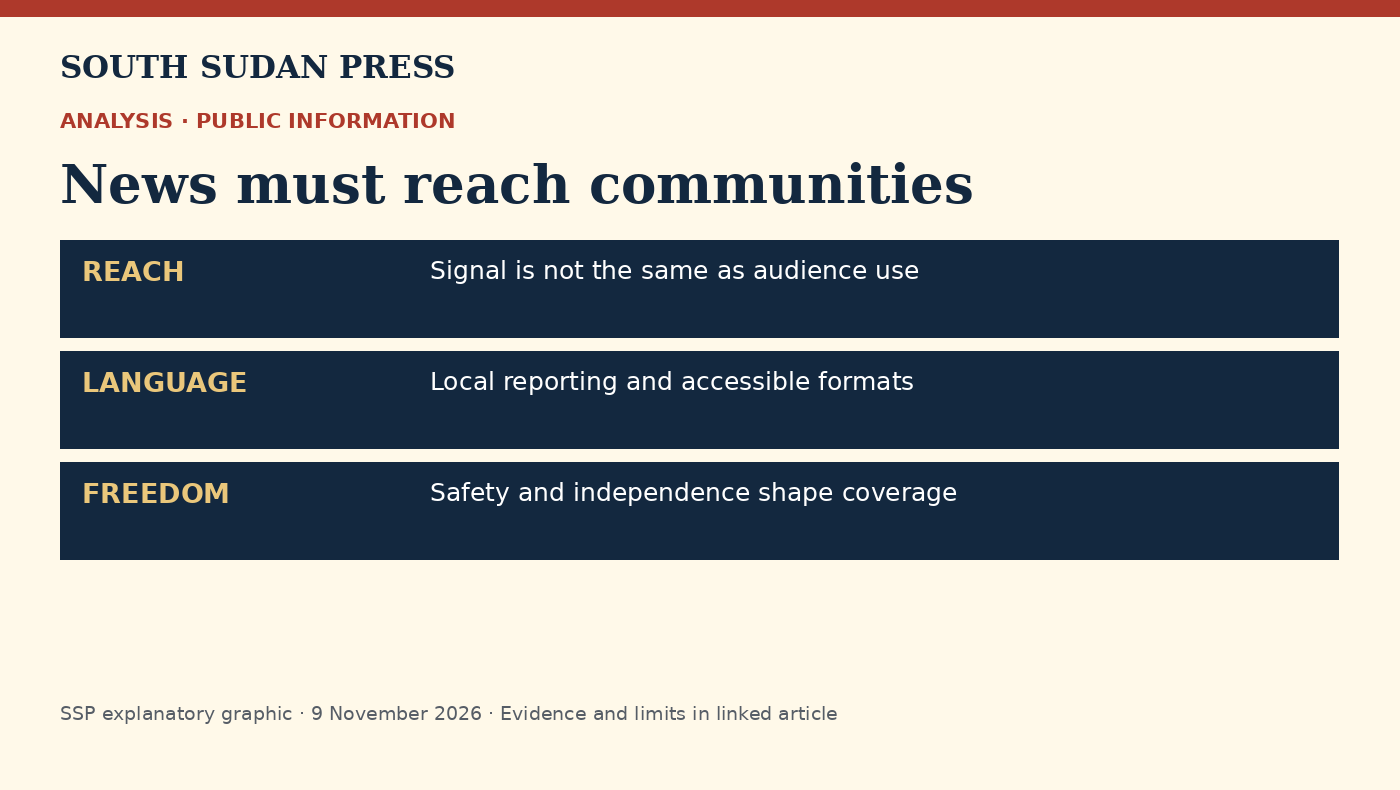
A story published in Juba is not automatically a story available across South Sudan. Distance, language, electricity, cost and security determine who can receive it, while newsroom resources influence which communities are heard in the first place.
UNESCO’s February 2026 account of radio rehabilitation identified work in Terekeka, Malakal, Wau, Yambio and the University of Juba. Those project locations indicate investment activity, not a verified map of transmitters operating nationwide in November.
UNMISS’s World Radio Day account reported that more than 60 per cent of respondents in a perception survey named radio as their main information source. The cited shares for social media, television and newspapers were 5.4, 3.5 and 1.8 per cent. These are survey responses, not the percentage of the country technically covered by each medium.
Three meanings of coverage
Technical reach asks whether a signal or connection is available. Audience use asks whether people actually listen, read or watch. Editorial coverage asks whether journalists report the issues and communities that matter. Confusing these measures can make a newsroom appear nationally representative because a website is accessible from abroad.
A radio transmitter may reach a county whose concerns rarely enter a bulletin. A mobile network may be available while a household cannot afford data. A widely shared Facebook post may circulate mainly among urban residents and diaspora audiences.
A credible national assessment would therefore combine a current station directory, audience research and a content audit. The sources reviewed do not establish comparable state-by-state audience percentages, and the accompanying reporting matrix deliberately leaves those fields unquantified.
Build a distribution chain with feedback
Newsrooms can prepare a verified article, a short radio script and a lightweight shareable summary from the same reporting. Translation should preserve names, dates, uncertainty and the distinction between an allegation and a finding. An audio version should carry the same corrections as the written story.
Local stations and community correspondents can identify questions that a capital-based desk misses. That relationship needs clear commissioning, payment and verification standards. A correspondent should not be expected to take personal security risks for an unpaid assignment or supply dramatic claims simply to attract attention.
Distribution should include a way for listeners to challenge an error. Call-ins, message channels and community feedback can help, provided editors protect personal information and do not broadcast an unverified accusation merely because it was submitted by a listener.
Freedom is part of the infrastructure
UNESCO’s October media-security work highlights that reporting conditions affect access to information alongside equipment. Training and dialogue may help professional relationships, but they do not substitute for the right to ask difficult questions and document misconduct.
Ownership and financial dependence also deserve attention. The audience should be able to distinguish a paid advertisement from editorial work and a party statement from independently checked reporting. Equal airtime alone cannot compensate for intimidation or the exclusion of local voices.
For election coverage, the immediate task is usable information: the source of a rule, its effective date, the place it applies and the route for a complaint. Repeating a national announcement without checking local access is insufficient.
What SSP can measure
SSP can track which counties appear in its reporting, whose voices are quoted, how many stories obtain a substantive response and how corrections reach the original audience. These are proposed newsroom measures, not claims about an audit already completed.
Growth should mean more people receiving useful, accountable reporting in forms they can access. Page views and followers can support that mission, but they cannot demonstrate it alone.
Coverage: what can currently be established?
| Dimension | Evidence in reviewed sources | What still needs verification |
|---|---|---|
| Radio infrastructure | UNESCO identifies five rehabilitation locations | November operational status, frequencies and actual signal reach |
| Audience preferences | UNMISS cites a perception survey | Current representative state-by-state audience shares |
| Editorial breadth | County reporting can be audited | Comparable newsroom-wide content data not established |
| Language access | UNESCO describes local-language role of radio | Current station schedules and audience comprehension |
| Reporting safety | UNESCO describes workshops and risks | Incident trends and verified outcomes after training |
This table is an evidence guide, not a station coverage map.
Sources and reporting note
- https://southsudan.un.org/en/310134-world-radio-day-unesco-rebuilding-radio-and-reconnecting-communities-south-sudan
- https://unmiss.unmissions.org/en/news/radio-miraya-sharing-peace-unity-and-hope-people-south-sudan-world-radio-day
- https://www.unesco.org/en/articles/unesco-helping-build-trust-between-journalists-and-security-personnel-south-sudan
Prepared from linked published reporting and primary sources. Analysis and proposed actions are identified as such. SSP does not claim to have conducted interviews or sent requests for this edition. Estimates and disputed claims retain their stated limitations.
Monday’s special reports
Graduates Need a Route Into Work, Not a Presumption of Violence
South Sudan’s News Gap Is About Reach, Language and Reporting Freedom
Internet Use Remains Below 20%, but Subscriber and Coverage Figures Need Care
Understand the process. Check your location.
SouthSudanElections.org — learn about election participation →
SouthSudanVoting.info — explore area guidance and voting information →
These are independent civic resources. Confirm registration dates, eligibility rules and centre locations against a current NEC notice. A registration centre is not automatically a polling station. A confirmed nationwide centre directory was not verified for this edition.
ADVERTISEMENT · CYBERPASS ACADEMY

Online learning planned from early 2027. Visit www.CyberPass.co for announcements. Course dates, fees and enrolment details to be announced.
ADVERTISEMENT · WEB SERVICES & DOMAIN NAMES

Build a home online for your business, school, NGO or charity. Ask about hosting, website development and selected short four-letter domain names, including names beginning or ending with SS.
Short. Memorable. Easy to say on radio. Each name is subject to availability and individual pricing.