ANALYSIS · YOUTH AND SECURITY · MONDAY, 9 NOVEMBER 2026
Graduates Need a Route Into Work, Not a Presumption of Violence
Employment exclusion can increase vulnerability to armed recruitment, but evidence does not support treating jobless graduates as an inevitable militia pipeline.
South Sudan Press · Analysis & data desk
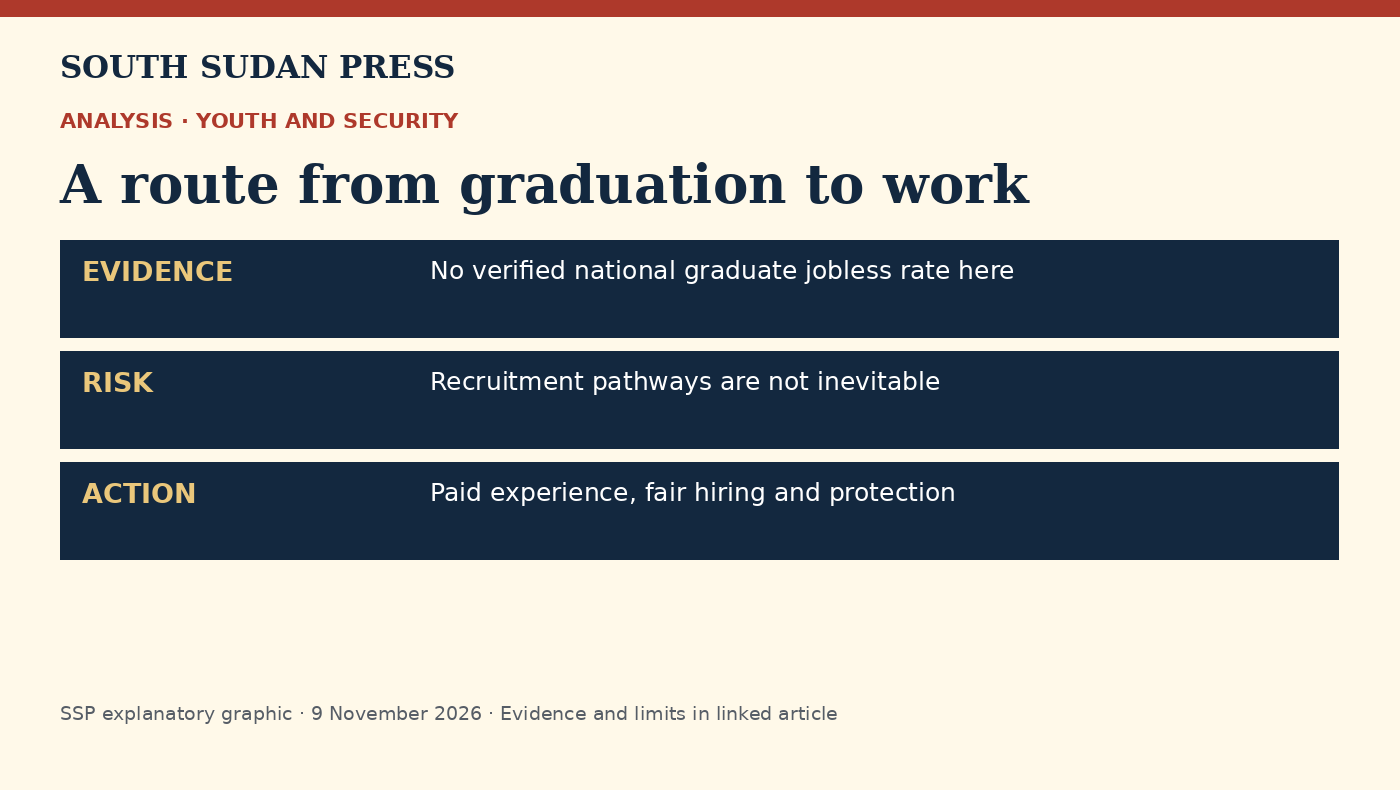
A university certificate can represent years of sacrifice without providing a clear route into paid work. For South Sudan’s graduates, the public debate should begin with that broken transition rather than with a blanket assumption that unemployment turns young people into fighters.
UNDP identifies scarce formal employment and a mismatch between skills and opportunities as important youth-development challenges. Its tracer-study publication, released in October 2025, examines vocational, technical and entrepreneurial training and points to the value of practical competence and workplace skills. It is not a nationally representative count of unemployed university graduates in November 2026.
That distinction matters. A person without a formal salaried job may still farm, trade or perform irregular paid work. An unemployment rate, an estimate of informal employment and a measure of young people outside education, employment or training answer different questions. None should be relabelled as a graduate-unemployment rate.
Why the security risk requires care
Economic insecurity can make promises of income, protection or status more attractive. Political networks, pressure from peers, local insecurity and coercion may also shape recruitment. These are plausible pathways requiring investigation, not a measured national probability that a jobless graduate will join a militia.
The evidence reviewed for this analysis does not establish how many university graduates have joined local armed groups or what share did so because they lacked employment. It would be misleading to invent either number.
Children require a separate protection response. UNICEF’s 2026 appeal identifies disrupted schooling as a factor increasing vulnerability to armed recruitment and other abuse. That warning concerns children and cannot simply be transferred to adult graduates as if the groups were interchangeable.
Young people should also be heard as civic organisers, workers, entrepreneurs and peacebuilders. Defining an entire generation primarily as a threat can reinforce exclusion and justify coercive treatment rather than solve a livelihood problem.
Build a transition that employers can use
Universities could start with graduate tracer surveys at six, twelve and twenty-four months. A credible survey would record field of study, location, gender, disability, work status, earnings bands and the route into employment. It should disclose non-response rather than presenting a small group of respondents as the whole graduating class.
Employers need a practical way to offer supervised placements, and graduates need paid experience that does not depend on family connections. Transparent recruitment, published selection criteria and a complaints channel would make internships more credible. A placement should have a defined learning plan and protection against indefinite unpaid labour.
Skills training should follow evidence of demand. Accounting, equipment maintenance, agricultural services, health support and digital work are examples to investigate, not a verified list of current vacancies. Programmes should establish who is hiring and what skills are missing before promising employment to trainees.
Livelihoods and protection must work together
Communities affected by armed mobilisation need safe reporting, credible civilian protection and support for people leaving armed groups. A training certificate cannot neutralise coercion or protect a family threatened by an armed recruiter.
Likewise, assistance should not reward a person for carrying a weapon while overlooking neighbours who remained civilians. Reintegration and employment programmes need transparent criteria and community consultation to avoid creating perverse incentives.
The measures of success should be sustained earnings, fair access to work and reduced exposure to coercion, not only the number attending a workshop. Government, universities, businesses and diaspora professionals can each contribute, but their commitments need dates, budgets and accountable delivery.
South Sudan’s graduates deserve a serious employment policy on its own merits. Reducing recruitment vulnerability is a further reason to act, not a reason to stigmatise those still searching for work.
From risk to a practical response
| Issue to investigate | Proposed response | Measure of delivery |
|---|---|---|
| Transition from graduation to work | Paid placements with transparent selection | Sustained work and earnings after placement |
| Mismatch between training and demand | Employer-linked practical learning | Verified skills use and hiring outcomes |
| Coercion and insecurity | Civilian protection and safe referrals | Accessible help without retaliation |
| Exclusion from decisions | Youth participation in programme design | Published selection and complaint records |
Sources and reporting note
- https://www.undp.org/south-sudan/publications/2023-tracer-study-and-employer-perception-survey-report
- https://www.undp.org/south-sudan/challenge
- https://www.unicef.org/media/177056/file/2026-HAC-South-Sudan.pdf
Prepared from linked published reporting and primary sources. Analysis and proposed actions are identified as such. SSP does not claim to have conducted interviews or sent requests for this edition. Estimates and disputed claims retain their stated limitations.
Monday’s special reports
Graduates Need a Route Into Work, Not a Presumption of Violence
South Sudan’s News Gap Is About Reach, Language and Reporting Freedom
Internet Use Remains Below 20%, but Subscriber and Coverage Figures Need Care
ADVERTISEMENT · CYBERPASS ACADEMY

Online learning planned from early 2027. Visit www.CyberPass.co for announcements. Course dates, fees and enrolment details to be announced.
ADVERTISEMENT · WEB SERVICES & DOMAIN NAMES

Build a home online for your business, school, NGO or charity. Ask about hosting, website development and selected short four-letter domain names, including names beginning or ending with SS.
Short. Memorable. Easy to say on radio. Each name is subject to availability and individual pricing.